
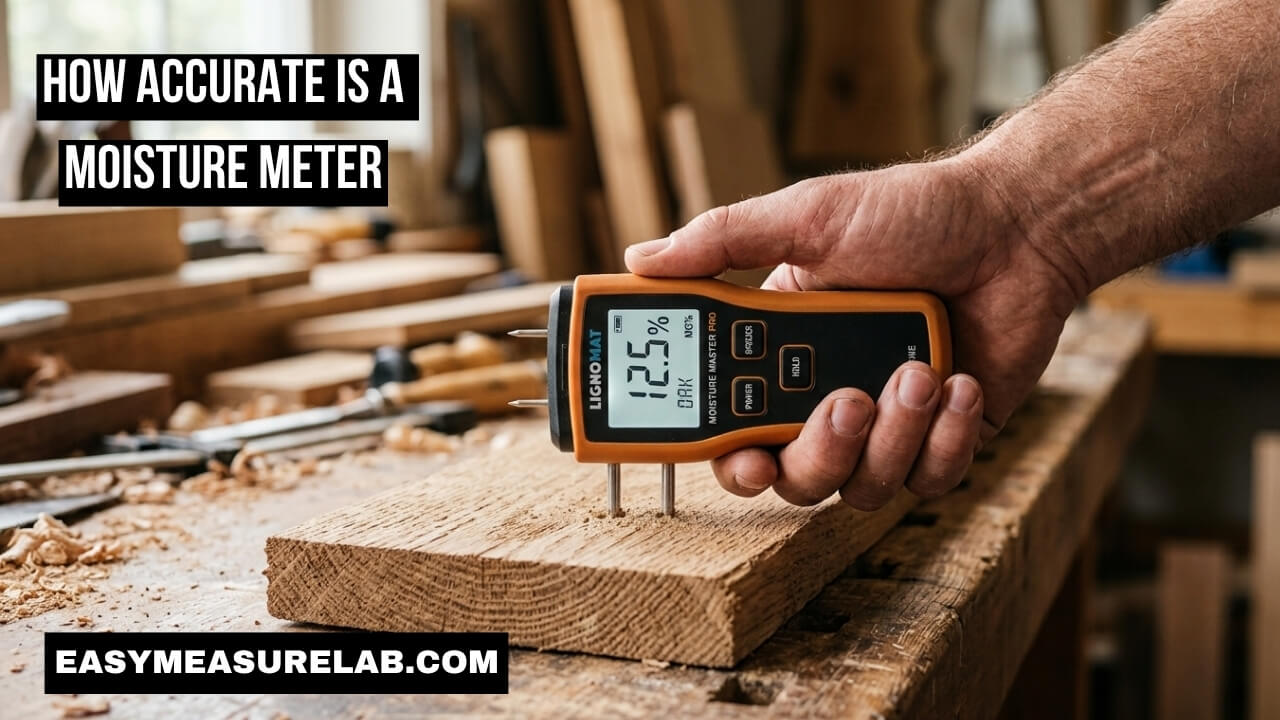
I still remember my first big house leak. Rain came through my roof. Water dripped down my kitchen wall. I was scared. I bought a cheap tool to check the wall. I wanted to see the hidden damage. But I quickly asked myself, how accurate is a moisture meter?
I thought the screen told the pure truth. I was wrong. The numbers jumped around. I got wild readings on the exact same spot. That day, I learned that these tools have limits. I spent the next few years testing many brands. I tested wood, drywall, and rock. I learned what works. I also learned what fails. Here is what you need to know.
The Real Truth: How Accurate Is a Moisture Meter?
Many people trust the digital numbers completely. But you must know how they work. They do not see water. They measure electric flow.
A good wood moisture meter is very exact. Most give you a reading within one percent of the true water level. But this only happens if you use it right. You must set the right wood type. You must check the heat of the room.
On drywall or floors, things change. These meters give you a relative scale. They do not give an exact water percent. They just tell you if a spot is wetter than a dry spot.
| Material Type | Expected Accuracy | What You Actually Get |
| Solid Wood Boards | Very High | Exact percent (like 12%) |
| Drywall and Plaster | Medium | Relative wetness scale |
| Hard Concrete | Low to Medium | Needs a deep hole test |
Pin vs. Pinless Moisture Meters: Which Wins?
You will find two main types of meters at the hardware store. I have used both types a lot. They both have pros and cons.
The type of tool you pick changes your accuracy. It also changes how you do your work. Let us look at both options in detail.
Pin Moisture Meters Explained
Pin meters have two sharp metal spikes. You push these pins deep into the wood. The tool shoots a tiny electric pulse between the pins. Water carries electricity. More water means less pushback against the pulse.
I love pin meters for finding the exact depth of a leak. If the top is dry but the core is wet, long pins will find the truth. But they do leave ugly holes in your nice wall.
Pinless Moisture Meters Explained
Pinless meters have a flat sensor pad. You press this pad flat against the wall or floor. It sends a signal deep into the wood. It reads the wetness without causing any damage at all.
I use pinless meters to scan big rooms fast. They are great for nice oak floors. But they can get tricked easily. Surface dew can mess up the reading. Hidden metal screws behind the wall can also ruin the math.
| Meter Type | Best Feature | Biggest Flaw |
| Pin Meter | Reads exact depth | Leaves ugly holes |
| Pinless Meter | No damage at all | Tricked by hidden metal |
5 Huge Mistakes That Ruin Moisture Meter Accuracy
I made many mistakes when I first started testing wood. You can buy the best tool in the world. But human error will ruin the results every time.
Here are the most common ways people ruin their readings. I have done almost all of these myself. Learn from my bad choices.
Mistake 1: Ignoring the Room Heat
Cold wood reads differently than hot wood. If you bring firewood inside from the freezing snow, your meter will lie to you. The wood will seem drier than it really is.
You must let the wood warm up. Let it sit in the room for a day. Some high-end meters do this math for you. Most do not.
Mistake 2: Testing the Wrong Wood Type
Every type of wood has a unique weight. Oak is very heavy. Pine is very soft and light. A good meter lets you pick the wood type before you test.
If you set your tool to oak but test a pine board, your numbers will be totally wrong. Always check the tool settings first.
Mistake 3: Surface Dew Tricking the Sensor
I once tested a wood deck after a light morning rain. The pinless meter screamed that the wood was soaked. But the wood was totally dry deep inside.
Only the very top layer was wet. Pinless meters get confused by top dew. You must wipe the wood completely dry. Then wait a few hours before you test it again.
Mistake 4: Hitting Hidden Metal
This happens a lot in houses. You scan a wall with a pinless pad. The meter beeps wildly. You think you have a massive pipe leak.
But you just scanned over a metal wall stud. Metal carries the electric signal better than water. Always move the tool a few inches left or right to double-check.
Mistake 5: Pushing Pins in the Wrong Way
Wood has a grain. The lines run up and down the board. When you use a pin meter, you must line up the pins with the grain.
Do not stab the pins across the lines. The electric pulse flows best with the grain. If you go across, the reading drops.
| Common Mistake | Why It Fails | How to Fix It |
| Cold Wood | Changes pulse flow | Let wood reach room heat |
| Wrong Wood Type | Weight changes the math | Check the meter setting |
| Hidden Wall Metal | Metal acts like water | Move tool two inches over |
Reading the Different Meter Scales
When you ask how accurate is a moisture meter, you must know what scale it uses. Most people just look at the big number. They do not look at the tiny letters next to it.
A meter usually has three modes. You must pick the right mode for your job.
The True Wood Scale
This is the most exact scale. It tells you the true percent of water in the wood. It goes from about five percent up to forty percent. You use this for building things or burning logs.
The Drywall Scale
Drywall does not have a set weight. It is dusty and full of air. This scale just gives you a basic number. It might go from one to fifty. It is just a guide.
The Reference Scale
You use this scale for brick, tile, or rock. It goes from zero to one hundred. It does not mean percent. It just means a score. A score of eighty is wetter than a score of twenty.
How I Test My Tool for Perfect Results
Tools get bumped around in your truck. They fall off ladders. Over time, they lose their exact tuning. You must check their accuracy often.
If you never test your tool, you are just guessing. I learned this the hard way. I built a coffee table with wet wood. The wood shrank. The table cracked down the middle.
Does Checking the Tool Actually Matter?
Yes. It is the only way to know if your tool tells the truth. Many good meters come with a small plastic block. This is a test block.
You turn the meter on. You press it to the block. The block has a set wetness score, like 18%. If your meter says 18%, you are safe. If it says 14%, your tool is broken. You can check out tool care tips on Family Handyman to keep your gear safe.
Testing Drywall vs. Wood vs. Concrete
You cannot treat all things the same way. Wood is the easiest thing to test. House walls are much harder.
When checking my basement, I saw the meter act weird. The concrete floor gave crazy numbers. The wood walls gave clear numbers.
Checking Drywall for Hidden Leaks
You use a meter here to find the edge of a water leak. You start on a known dry spot. You see the normal number.
Then you slide the tool toward the wet spot. When the number jumps high, you found the hidden water. It is about comparing spots. The EPA provides great tips on mold and water if you find wet walls.
Checking Concrete House Floors
Never trust a standard wood meter on a rock floor. Concrete holds water deep down inside the slab. The top might feel totally dry.
To test concrete, pros drill a hole. They drop a tiny sensor inside. This takes a full day. A standard pin meter will just bounce off the hard rock.
| Material Tested | Best Testing Method | Accuracy Goal |
| Wood Boards | Pin or Pinless Tool | Exact water percent |
| House Drywall | Pin Tool | Find the wet edges |
| Concrete Floor | Deep Hole Sensor | Deep slab wetness |
Do Cheap Moisture Meters Actually Work?
I bought a cheap twenty-dollar meter from a local store. Later, I bought a three-hundred-dollar pro model. I wanted to see the real truth.
The answer is yes and no. Cheap tools work for basic, easy jobs. But they fail fast when you need exact numbers.
The Huge Problem With Cheap Models
Cheap meters do not let you pick the wood type. They assume all wood is the exact same. This is a huge flaw.
They also lack heat correction. If you just want to know if firewood is dry enough to burn, a cheap tool is fine. If you are building a fine desk, a cheap tool will ruin your hard work.
Why Pro Models Cost So Much Money
Expensive meters use better internal parts. The metal pins do not snap off in hard oak. The smart brain inside does complex math in a split second.
Brands like Wagner or Delmhorst are trusted by house builders. They offer charts, extra long wires, and long warranties. You pay for pure peace of mind. The Forest Products Lab often relies on high-end tech for true wood facts.
Real World Uses: Where I Test for Water
I use my meter all the time. It is not just for fixing leaks. It is a daily tool for my home projects.
Here are the most common ways I use it. These real tests show how accurate the tool can be.
Finding Roof Leaks in the Attic
Water travels far from the actual roof hole. It runs down beams. I take my pin meter into the attic. I test the wood beams.
I follow the highest numbers. The numbers lead me right to the bad roof shingle.
Checking RVs and Campers
Campers leak all the time. The walls are very thin. I use a pinless meter here. I scan the walls near the windows.
If the meter beeps, I know water got past the window seal. This saves me from buying a rotten camper.
Buying Wood at the Big Box Store
Wood from the store is often very wet. They rush it out of the mill. I bring my meter to the store.
I test the boards before I buy them. If the board is over twelve percent, I put it back. This stops my projects from warping later on.
| Project Type | Target Moisture | Needed Accuracy |
| Winter Firewood | Under 20% | Low to Medium |
| House Wall Framing | 15% to 19% | Medium |
| Fine Indoor Furniture | 6% to 9% | Extremely High |
Room Air Factors That Mess With Readings
Your testing room matters a lot. You cannot ignore the air around you. The room changes how the meter reads the wood.
I once tested floor boards in a very humid shed. The numbers were crazy high. Here is what you need to watch out for.
High Room Air Humidity
If the air is very wet, the wood will pull in that water. Wood acts just like a dry sponge.
If you store dry wood in a damp garage, it will read wet on the meter. The meter is accurate. The wood just soaked up the damp air.
Chemical Wood Treatments
Green treated wood is full of heavy chemicals. These chemicals protect the wood from bugs and rot outside.
But these chemicals also carry electricity. If you use a pin meter on treated wood, the reading will spike. The meter thinks the chemicals are water. You have to use special modes for treated wood.
| Room Factor | How It Hurts Accuracy | The Best Solution |
| High Humidity | Wood acts like a sponge | Store wood indoors |
| Wood Chemicals | Conducts fake signals | Use special meter modes |
| Low Battery | Weakens sensor power | Change batteries often |
Can Low Batteries Change Your Reading?
This is a hidden danger. When your battery gets weak, the tool might still turn on just fine. The screen might still light up bright.
But a weak battery sends a weak electric pulse. A weak pulse gives you a fake low reading. You might think your wall is dry. In reality, your battery is just dying.
I change my batteries every single big project. It saves me from terrible mistakes. It costs two dollars. It saves thousands.
How to Know If Your Moisture Meter Is Broken
Tools break. Sometimes you drop them on hard floors. Sometimes the internal wires just give up. You need to know the signs of a broken tool.
I once spent an hour trying to dry out a floor. The meter kept saying thirty percent. I finally realized the meter was just frozen on that number.
The Metal Pins Are Loose
If you use a pin meter, check the metal spikes. They must be very tight. If they wiggle, the electric loop breaks.
You will get wild jumping numbers. Or you will get a pure zero. Always carry extra pins. You can unscrew the broken ones and put fresh ones in quickly.
The Screen Flickers On and Off
If the screen blinks or fades, stop testing. The internal board is failing.
Meters live in wet, dirty places. Sometimes water gets inside the tool itself. If your tool gets wet, take out the battery. Let the tool sit in a warm, dry room for a few days. You can learn more about finding water signs from experts like InspectAPedia.
Firewood vs. Building Boards: A Different Rule
I use my meter for two very different jobs. I check logs for my winter fire. I also check flat lumber for building nice cabinets.
You need to judge the accuracy differently based on your goal. Firewood does not need to be perfect. Cabinets do.
Testing Firewood Quickly
Firewood should be under twenty percent wetness. If it is drier than that, it burns hot and clean. It will not smoke up your house.
You do not need a perfect exact reading. If the meter says 17% or 19%, you are totally fine. Just split the log open first. Test the fresh inside center. The outside bark is always dry.
Testing Fine Furniture Wood
Furniture needs to be around eight percent wetness. A change of just two percent will warp a flat table.
For this, you need extreme accuracy. You must use the wood type setting. You must check many spots on the board. You cannot rush this job.
Final Thoughts
So, how accurate is a moisture meter? It is exactly as accurate as the person holding it in their hand. These tools are amazing, but they are not magic.
I learned that you have to control the room air. You must set the correct wood type. You must keep fresh pins in the top. If you buy a decent brand and keep fresh batteries in it, you will get true numbers every time.
If you are just burning logs, a cheap tool works fine. If you are fixing a flooded house or building a desk, spend the extra money. It will save you from a massive headache later on. Trust your tool, but verify the facts.
Frequently Asked Questions (FAQs)
How accurate is a moisture meter on drywall?
They are not exact on drywall. They give a basic relative scale. You use them to compare a wet spot to a known dry spot to find the leak edges.
Can a moisture meter be wrong?
Yes. A low battery, the wrong wood setting, or freezing cold temperatures can make the reading totally wrong. Always check your tool settings first.
Do I need a pin or pinless moisture meter?
Use a pin tool to find deep leaks inside thick walls. Use a pinless tool to scan nice wood floors fast without leaving any ugly holes behind.
How do I test my moisture meter for accuracy?
Use a small plastic test block. Most good tools come with one. You press the tool to the block to see if the screen numbers match the block numbers perfectly.
What is a safe moisture reading for wood?
For indoor wood desks, you want 6% to 9%. For outdoor house framing wood, up to 15% is okay. For winter firewood, it must be under 20% to burn clean.