
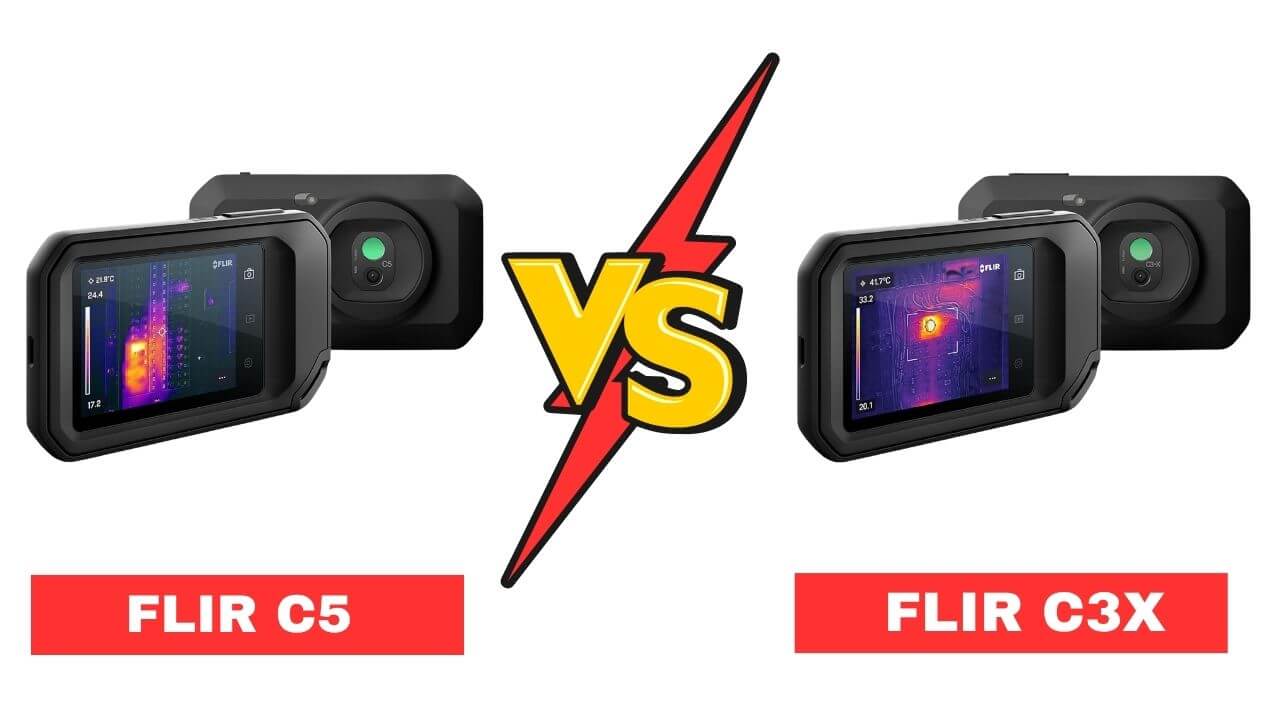
A hot spot can hide in a panel, pipe, or wall. A good thermal camera can make that fault easier to spot. FLIR C5 vs C3X comes down to image detail, heat range, and control. This guide breaks down the key gaps in simple terms.
FLIR C5 Review
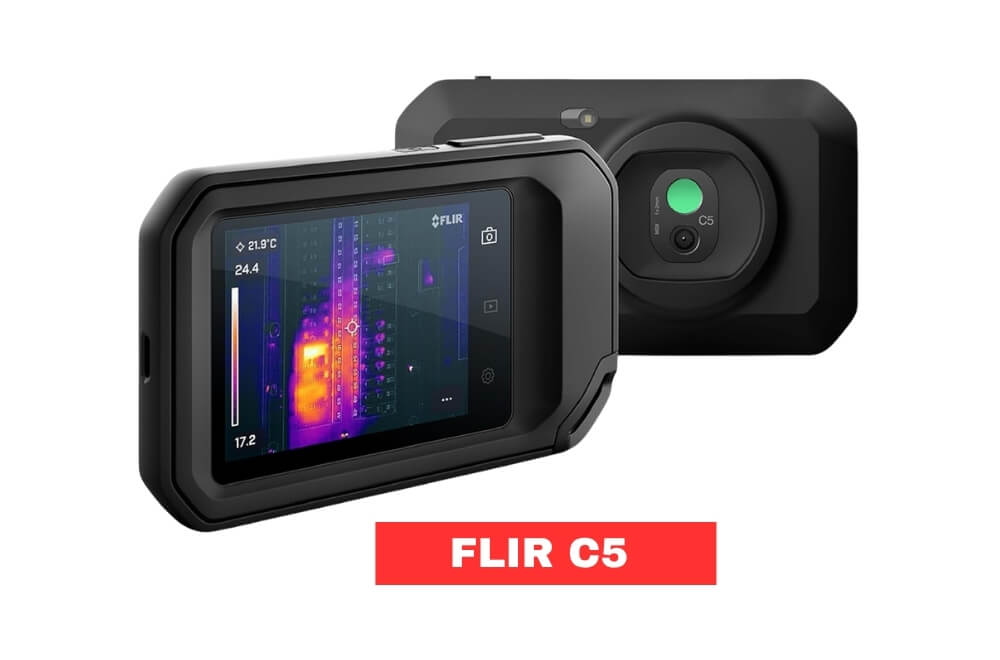
The C5 is a compact thermal camera with a 160 × 120 IR sensor. It measures from -20°C to 400°C. It also has MSX, a 5 MP visual camera, Wi-Fi, and cloud storage.
Pros and Cons
The main strengths come from its higher thermal detail and wider heat range.
| Type | Feature | Practical Impact |
|---|---|---|
| Pro | 160 × 120 IR | Shows more thermal detail. |
| Pro | 400°C max range | Handles hotter targets. |
| Pro | 5 MP visual camera | Adds clear scene detail. |
| Pro | 1-Touch Level/Span | Gives more image control. |
| Con | Focus-free lens | No manual focus control. |
| Con | Focus-free lens | No manual focus control. |
Thermal Image Detail
The 160 × 120 sensor gives 19,200 thermal pixels. That is more than the 12,288 pixels in the C3-X. More pixels can help show more detail on small targets.
MSX adds visible edges to the thermal view. This can make wires, parts, and other targets easier to match. The C5 also offers 1-Touch Level/Span control.
| Feature | C5 Detail | Why It Helps |
|---|---|---|
| IR resolution | 160 × 120 | More thermal pixels. |
| Thermal pixels | 19,200 | Shows more image detail. |
| MSX | Yes | Adds visible edges. |
| Level/Span | 1-Touch | Gives more contrast control. |
| Visual camera | 5 MP | Adds scene detail. |
Recommendation
The C5 fits jobs where extra thermal detail or a wider heat range matters most.
| User Type | Recommendation | Reason |
|---|---|---|
| Electricians | Good Fit | More detail for fault checks. |
| HVAC users | Good Fit | Wider heat range helps. |
| Maintenance teams | Good Fit | Strong image tools. |
| Basic home checks | Not Ideal | Extra range may not be needed. |
| Low-heat work | Not Ideal | A simpler model may be enough. |
FLIR C3X Review
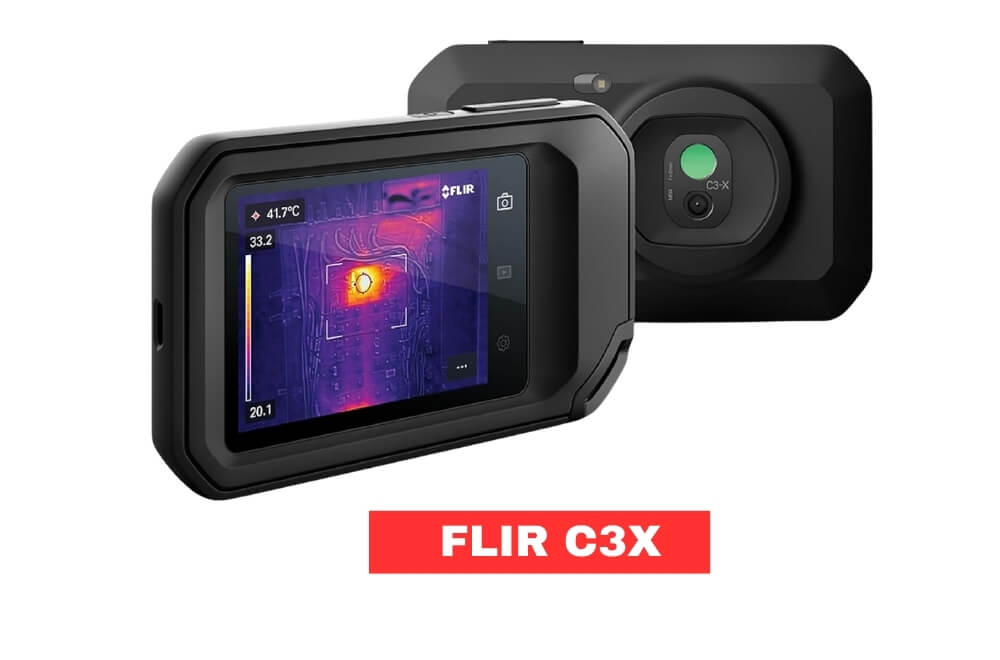
The C3-X uses a 128 × 96 IR sensor. It measures temperatures from -20°C to 300°C. It also has MSX, a 5 MP visual camera, Wi-Fi, and cloud storage.
The thermal sensor gives 12,288 pixels. That can cover many basic inspection tasks. Its compact body also has an IP54 rating and a 2 m drop rating.
Pros and Cons
The C3-X keeps many useful tools while using a lower-resolution thermal sensor.
| Type | Feature | Practical Impact |
|---|---|---|
| Pro | 128 × 96 IR | Good for basic checks. |
| Pro | 300°C max range | Covers many common jobs. |
| Pro | 5 MP visual camera | Shows the target scene. |
| Pro | Wi-Fi | Supports easy file sharing. |
| Con | Lower IR resolution | Shows less thermal detail. |
| Con | Automatic Level/Span | Gives less manual control. |
Everyday Inspection
The C3-X suits broad heat checks. It can help show clear temperature changes in panels, pipes, and equipment. MSX adds visible detail to the thermal image.
The 128 × 96 sensor has less detail than the C5. The 300°C limit also gives less room for hotter targets. For simple inspection work, those limits may not matter.
| Feature | C3-X Detail | Practical Result |
|---|---|---|
| IR resolution | 128 × 96 | Good for broad heat changes. |
| Thermal pixels | 12,288 | Less detail than C5. |
| MSX | Yes | Adds visible edges. |
| Level/Span | Automatic | Keeps control simple. |
| Visual camera | 5 MP | Shows scene detail. |
Recommendation
The C3-X makes more sense when basic thermal work is the main goal.
| User Type | Recommendation | Reason |
|---|---|---|
| DIY users | Good Fit | Simple heat checks. |
| Home inspectors | Good Fit | Good for broad targets. |
| Light maintenance | Good Fit | Covers common tasks. |
| High-heat work | Not Ideal | 300°C limit may be low. |
| Small target checks | Not Ideal | Lower thermal detail. |
Detailed Comparison for FLIR C5 vs C3X
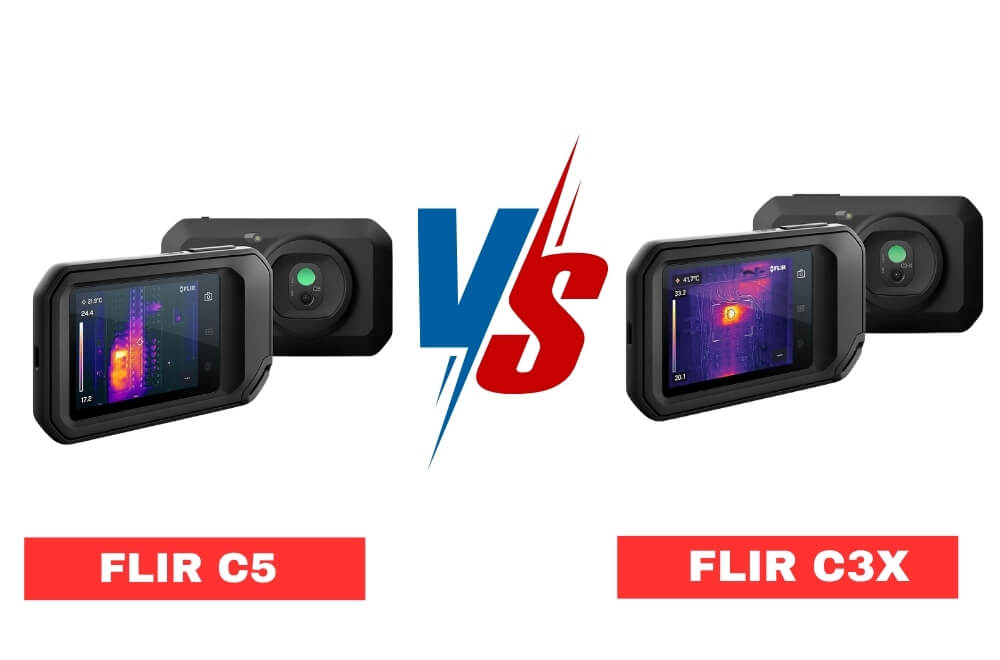
Both cameras share many core tools. The key gaps are easier to see when the models are placed side by side.
Performance: FLIR C5 vs C3X
The C5 has a 160 × 120 thermal sensor. The C3-X has a 128 × 96 sensor. That gives the C5 more thermal pixels.
The C5 also reaches 400°C. The C3-X reaches 300°C. The C5 therefore has more room for hotter targets and more thermal pixels for added image detail.
| Feature | FLIR C5 | FLIR C3X |
|---|---|---|
| IR resolution | 160 × 120 | 128 × 96 |
| Thermal pixels | 19,200 | 12,288 |
| Max temperature | 400°C | 300°C |
| Image frequency | 8.7 Hz | 8.7 Hz |
| Thermal sensitivity | <70 mK | <70 mK |
- FLIR C5 Rating: 9/10
- FLIR C3X Rating: 8/10
Ease of Use: FLIR C5 vs C3X
Both models use a touch screen and a focus-free design. Both support infrared, visual, MSX, and picture-in-picture views.
The C5 adds 1-Touch Level/Span control. The C3-X uses automatic Level/Span. The C3-X keeps the process simple, while the C5 gives more direct control.
| Feature | FLIR C5 | FLIR C3X |
|---|---|---|
| Touch screen | Yes | Yes |
| Focus | Focus free | Focus free |
| Level/Span | 1-Touch | Automatic |
| MSX | Yes | Yes |
| Picture-in-picture | Yes | Yes |
- FLIR C5 Rating: 9/10
- FLIR C3X Rating: 8.5/10
Build Quality: FLIR C5 vs C3X
Both models are made for portable inspection work. Both have an IP54 rating for water and dust protection. Both are designed to withstand a 2 m drop.
That makes the build gap quite small. Neither model has a clear advantage in basic protection. Both use a compact pocket-style body.
| Feature | FLIR C5 | FLIR C3X |
|---|---|---|
| Water and dust rating | IP54 | IP54 |
| Drop rating | 2 m | 2 m |
| Body style | ||
| Size | 138 × 84 × 24 mm | 138 × 84 × 24 mm |
- FLIR C5 Rating: 9/10
- FLIR C3X Rating: 9/10
Maintenance: FLIR C5 vs C3X
Both models support Wi-Fi and cloud connectivity. Both can store images in internal memory. This makes image handling easier after an inspection.
Both also support automatic software updates over Wi-Fi. Each model has a folder-based image gallery. Both use USB-C for charging and data transfer.
| Feature | FLIR C5 | FLIR C3X |
|---|---|---|
| Wi-Fi | Yes | Yes |
| Cloud storage | Yes | Yes |
| Internal memory | yes | yes |
| Software updates | Wi-Fi | Wi-Fi |
| USB | USB-C | USB-C |
- FLIR C5 Rating: 9/10
- FLIR C3X Rating: 8.5/10
Value for Money: FLIR C5 vs C3X
The C3-X covers many basic thermal inspection needs. Its lower thermal resolution may be enough for larger heat areas. The C5 adds more thermal pixels and a higher temperature limit.
The better choice depends on the work. Basic checks can suit the C3-X well. Small targets and hotter parts give the C5 a stronger case.
| Feature | FLIR C5 | FLIR C3X |
|---|---|---|
| Thermal resolution | 160 × 120 | 128 × 96 |
| Max temperature | 400°C | 300°C |
| Image control | 1-Touch Level/Span | Automatic Level/Span |
| MSX | Yes | Yes |
| Best use | More demanding checks | Basic checks |
- FLIR C5 Rating: 9/10
- FLIR C3X Rating: 9/10
Conclusion
The C5 is the better fit when thermal detail and a 400°C range matter. The C3-X is a sensible choice for basic checks and lower heat levels. For small targets or hotter parts, the C5 has the clearer edge.
FAQs
Is FLIR C5 vs C3X mainly about thermal resolution?
Yes. The C5 uses 160 × 120 IR resolution. The C3-X uses 128 × 96.
| Model | IR Resolution | Thermal Pixels |
|---|---|---|
| FLIR C5 | 160 × 120 | 19,200 |
| FLIR C3X | 128 × 96 | 12,288 |
Which model has the higher temperature range?
The C5 measures up to 400°C. The C3-X measures up to 300°C.
| Model | Temperature Range | Max Temperature |
|---|---|---|
| FLIR C5 | -20°C to 400°C | 400°C |
| FLIR C3X | -20°C to 300°C | 300°C |
Do both models support MSX?
Yes. Both models support MSX. Both also offer visual and picture-in-picture modes.
| Feature | FLIR C5 | FLIR C3X |
|---|---|---|
| MSX | Yes | Yes |
| Visual mode | Yes | Yes |
| Picture-in-picture | Yes | Yes |
Which model has more image control?
The C5 has 1-Touch Level/Span adjustment. The C3-X uses automatic Level/Span.
| Model | Level/Span | Control |
|---|---|---|
| FLIR C5 | 1-Touch | More direct control |
| FLIR C3X | Automatic | Simpler control |
Which model is better for small hot spots?
The C5 is the stronger choice when extra thermal detail matters. Its 160 × 120 sensor has more thermal pixels than the C3-X. That can provide more image detail on small targets.
| Model | Thermal Pixels | Small Target Edge |
|---|---|---|
| FLIR C5 | 19,200 | Higher |
| FLIR C3X | 12,288 | Lower |