
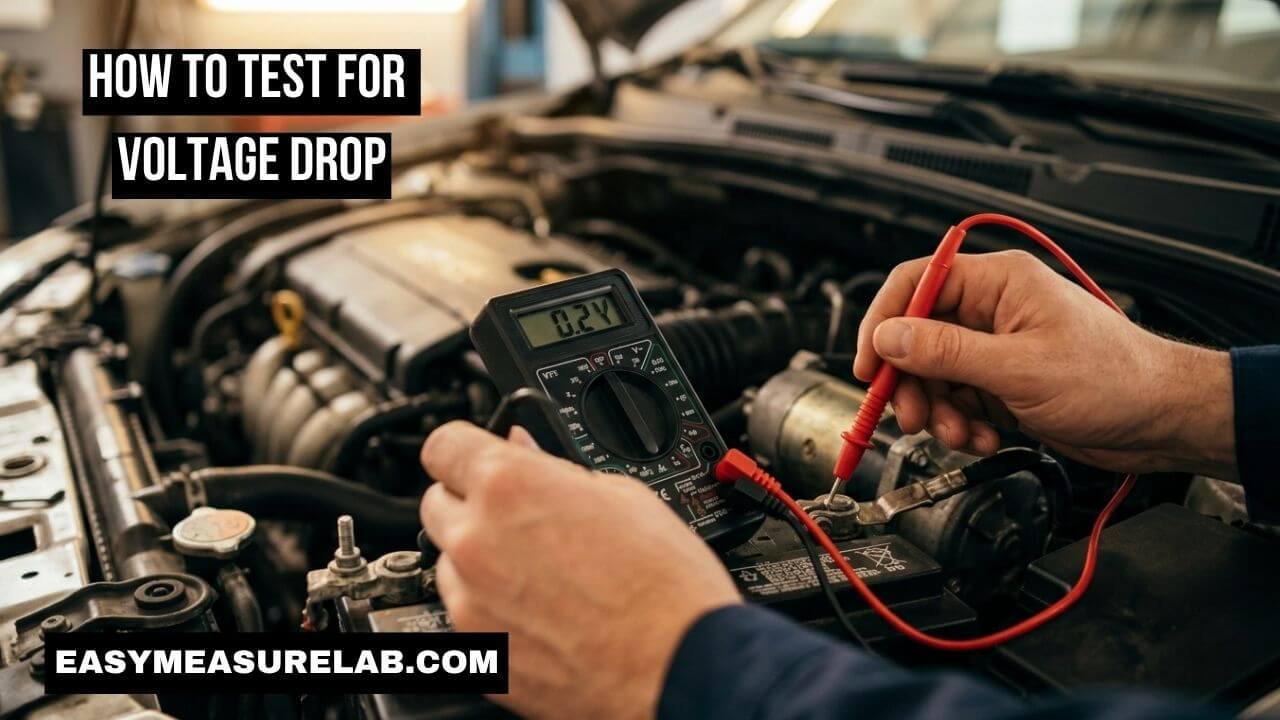
I remember my first bad car starter. The engine cranked very slow. I assumed the starter was dead. I bought a new one. I spent hours putting it in. I turned the key. The car still cranked slow. I wasted money. I wasted a whole Saturday. I felt so mad.
Then an older mechanic asked me a simple question. He asked if I knew how to test for voltage drop. I said no. I did not even know what that meant. He showed me. It changed how I fix cars forever. The problem was not the starter. The problem was a rusty ground wire. If you learn this skill, you will save money. You will stop guessing. You will fix things right the first time.
Why You Must Learn This Skill
I used to test wires the wrong way. I used the ohms setting on my meter. I checked for continuity. The meter beeped. I thought the wire was good.
But a continuity test lies to you. A thick battery cable can rot inside. It might only have one tiny strand of copper left. That one strand will make the meter beep. But that one strand cannot start a heavy car engine.
Power needs a wide path to flow. A bad wire acts like a kink in a water hose. The water still drips out. But you cannot wash a car with a drip. Voltage drop testing proves if the whole “hose” is clear.
| Old Habit | Why It Fails | Better Approach |
| Guessing parts | Wastes tons of money | Test first, buy later |
| Visual checks | Wires rot under the plastic | Use a meter to prove it |
| Ohms test | Passes bad wires | Voltage drop test under load |
Learning how to test for voltage drop is the only true way to check a wire.
Tools You Need for the Job
You do not need fancy gear. I use simple tools. You probably have them in your garage right now.
First, you need a digital multimeter. A cheap one works fine. It just needs a DC voltage setting.
Second, you need long test leads. The standard leads on a meter are too short. You cannot reach the battery and the back of the car at the same time. I bought a spool of wire and made my own long leads.
Third, you need safety glasses. You will work near battery acid. You will work near spinning engine belts. Keep your eyes safe.
The Water Hose Trick to Understand Wires
Think of your car battery as a water pump. Think of the wire as a big hose. Think of the starter as a water wheel.
When the pump runs, water pushes the wheel. If the hose is clean, all the pressure hits the wheel. The wheel spins fast.
But what if the hose has a kink? The pressure stops at the kink. The pressure drops. The wheel gets a weak trickle. The wheel spins slow.
In a car, voltage is the pressure. A dirty connection is the kink. When you lose voltage at a bad connection, we call that a voltage drop.
Step 1: Prep the Circuit
You must test the circuit while it works. This is a huge rule. Do not turn the power off. Do not unplug the wire.
If water does not flow, you cannot find the kink. If electricity does not flow, you cannot find the drop.
If you want to test a fuel pump, the pump must run. If you want to test a headlight, the headlight must be on. If you want to test a starter, you must crank the engine.
This is where I messed up early on. I unplugged things to test them. That is wrong. Leave it all plugged in.
Step 2: Set Up Your Meter
Grab your digital multimeter. Look at the dial.
Turn the dial to DC Volts. Look for the letter V with straight lines above it. Do not pick the V with a wavy line. The wavy line is for house power. You want car power.
Plug the black probe into the COM port. Plug the red probe into the V port.
Turn the meter on. Make sure it reads zero. You are ready to go.
Step 3: Test the Positive Side
Let us test a starter. The starter has a thick red wire. This wire goes to the positive battery post.
Take your red meter probe. Touch it right to the metal lead on the positive battery post. Do not touch the clamp. Touch the actual battery post.
Take your black meter probe. Touch it to the big metal stud on the starter. This is where the red wire ends.
Now, ask a friend to turn the car key. The engine will crank. Look at your meter screen while the engine cranks.
The meter will show a number. This number is your voltage drop.
| Meter Reading | What It Means | My Advice |
| 0.1 to 0.4 Volts | Wire is great | Look for another problem |
| 0.5 to 1.0 Volts | Wire is getting bad | Clean the connections soon |
| Over 1.0 Volts | Wire is totally ruined | Fix this exact wire now |
If the screen says 0.2 volts, the wire is perfect. If the screen says 2.5 volts, you found a massive kink in the hose. The red wire is bad.
Step 4: Test the Negative Side (Ground)
Many people test the red wire. They forget the black wire. This is a fatal mistake.
Power must go back to the battery. The metal frame of the car acts as the return wire. We call this the ground.
Most electrical bugs hide in the ground path. Rust is a bad conductor. Paint is a bad conductor. Dirt ruins grounds.
Keep your meter on DC Volts. Take your black probe. Touch it to the negative battery post. Touch the lead metal, not the clamp.
Take your red probe. Touch it to the metal case of the starter.
Have your friend crank the engine again. Look at the meter.
If the meter shows more than 0.2 volts, your ground is bad. The starter cannot push power back to the battery. You must clean the rust off the starter mount.
How to Test for Voltage Drop on an Alternator
Your alternator charges the battery. If it fails, your car dies while driving. Sometimes the alternator is fine. The wire is just bad.
Start the car engine. Turn on the headlights. Turn on the radio. Turn on the heater fan. You need a heavy load on the system.
Touch the red probe to the big bolt on the back of the alternator. Touch the black probe to the positive battery post.
Look at the meter. A good charge wire will show less than 0.3 volts. If you see 1.5 volts, the wire is fried. The alternator is trying to charge. The bad wire blocks the power. Do not buy a new alternator. Buy a new wire.
Testing a Fuel Pump Circuit
Fuel pumps live in the gas tank. They push fuel to the engine. When they get weak power, the engine starves. The car might stutter.
You can learn how to test for voltage drop here, too.
Find the power wire near the gas tank. Pierce it gently with a sharp pin. Touch your red probe to the pin. Touch your black probe to the positive battery post.
Turn the car key on. The pump will prime for a few seconds. Watch the meter fast.
A long wire can drop a little more voltage. Up to 0.5 volts is okay. If you see 2.0 volts, the fuel pump is starving. Clean the relay contacts. Check the fuse box.
Why Headlights Look Dim
Dim headlights are scary at night. People buy bright LED bulbs to fix this. But the bulbs are not the root problem.
The problem is old wiring. Old thin wires get hot. Heat creates resistance. Resistance causes a voltage drop.
Turn your headlights on. Touch the red probe to the positive battery post. Touch the black probe to the power wire right behind the headlight bulb.
If the meter says 1.5 volts, your bulb is losing a lot of light. You have a voltage drop.
| Problem Part | Max Allowed Drop | Action Needed |
| Starter Cable | 0.5 Volts | Clean battery terminals |
| Alternator Wire | 0.3 Volts | Replace thick charge cable |
| Computer Sensor | 0.1 Volts | Clean tiny pin connectors |
Computer sensors are very picky. A drop of 0.2 volts can trigger a check engine light. You must fix it.
Common Mistakes I Made Early On
I made many errors when I learned this. I want to save you from my pain.
First, I tested without a load. I turned the car off. I touched the probes to the wire. The meter said 0.0 volts. I thought the wire was fine. I was wrong. You must test while power flows.
Second, I pierced wires too deep. I broke the copper inside. Use very thin back-probe pins. Slide them gently into the back of a plug. Do not stab the wire dead center.
Third, I forgot to clean the battery first. Dirty battery posts mess up every test. Clean them with a wire brush before you pick up a meter.
| My Mistake | The Bad Result | How I Fix It Now |
| Testing dead circuit | Meter reads zero drop | Always test while it runs |
| Touching dirty metal | Meter jumps all over | Scratch rust off first |
| Ignoring grounds | Replaced good parts | Always test ground path |
Learn from my bad days. Your tests will go much better.
Finding the Exact Bad Spot
Let us say you found a drop. Your long red wire loses 2 volts. You know the wire is bad. But where is it bad? The wire is ten feet long.
You can find the exact bad spot. Move your probes closer together.
Keep one probe on the battery. Move the other probe halfway down the wire. Test it again.
If the meter still says 2 volts, the bad spot is in that first half.
If the meter says 0.1 volts, the first half is good. The bad spot is in the second half.
Move your probes closer and closer. You will cross the bad spot. Suddenly the meter will jump up. You found the exact spot. It might be a green, crusty connector. It might be a smashed wire. Now you know where to cut and splice.
The Magic of the Half-Split Method
Mechanics call this the half-split trick. It saves hours of time.
Do not rip open the whole wire harness. That takes all day. Just test the middle. Then test the next middle.
You divide the problem in half every time. You will find the bad plug in five minutes. This makes the job fast. It makes the job fun.
Fixing a Bad Ground Connection
Ground drops are my main enemy. Cars use steel frames for grounds. Steel rusts. Rust ruins power flow.
If you find a ground drop, the fix is cheap. You do not need parts. You just need a wire brush and some grease.
Take the ground bolt out. Scrub the wire ring with the brush. Scrub the car frame until the metal shines bare. Put the bolt back in tight.
Cover the bare metal with dielectric grease. This stops water. It stops rust. Test it again. Your voltage drop will be gone.
Upgrading the Big Three Wires
Some car audio guys know this secret. They upgrade the “Big Three” wires. This fixes many voltage drop issues at once.
The Big Three are the main power routes.
First is the alternator positive to battery positive.
Second is the battery negative to the car body.
Third is the engine block to the car body.
Factory wires are very thin. They save the car maker money. But they cause drops as the car ages.
If you cut out the thin wires and put in thick custom cables, the power flows easy. Headlights get brighter. The starter spins faster. The radio sounds louder. It is a smart fix.
Real World Example: The Clicking Relay
My friend had a truck. He turned the key. The truck just clicked. Click. Click. Click.
He bought a new battery. Still clicked. He bought a new starter. Still clicked. He was ready to sell the truck.
I brought my meter. I did a voltage drop test on his ground wire. The meter showed 10 volts of drop on the ground side.
The main ground wire looked fine on the outside. But inside, right near the battery, it was full of green powder. The copper was gone.
We cut the wire. We crimped a new end on it. We bolted it down. The truck started instantly. It cost him two dollars to fix. It cost him two hundred dollars to guess.
How Sensors Suffer from Voltage Drop
Cars today run on computers. The computer reads sensors. Sensors run on 5 volts. This is a very tiny amount of power.
If a sensor wire has a voltage drop of just 0.5 volts, the computer goes blind. It reads the wrong data.
The car might idle rough. It might shift hard. It might burn too much gas.
If you get a sensor code, do not replace the sensor right away. Learn how to test for voltage drop on the sensor wire.
Put your probes on each end of the sensor ground. If you see a drop, fix the wire. The sensor is probably fine.
Keeping Your Tools Safe
Your meter is your best friend. Treat it well.
Do not drop it. The screen will break. Do not leave it in the rain.
When you finish testing, turn the dial to OFF. If you leave it on DC Volts, the battery will die.
Take the leads out of the ports. Wrap them up neat. Put the meter in a soft case. A good meter will last for twenty years if you protect it.
You can read more about electrical safety from the experts at Fluke. They make the best meters in the world.
Practice Makes You Perfect
The first time you do this, you will feel clumsy. You will drop a probe. You will read the screen wrong. That is okay.
I messed up my first ten tests. I got frustrated. But I kept trying.
Go out to your car today. It runs fine, right? Test it anyway. Test a good circuit.
See what a 0.1 volt drop looks like. See how the meter reacts. If you practice on a good car, you will know exactly what to look for on a broken car.
Top mechanics, like those certified by ASE, practice this daily.
A Note on Battery Health
You cannot test wires if your battery is dead. A dead battery ruins the test.
Before you test for drops, check the battery voltage. Put the meter across the two posts. The car should be off.
A good battery shows 12.6 volts. A dead battery shows 11.9 volts or less.
If your battery is low, put it on a charger. Let it charge full. Then start your voltage drop tests.
You can learn all about battery chemistry at Battery University. It is a great place to read.
Dealing with Corrosion
Corrosion is the white fuzzy stuff on battery terminals. It is acid. It eats copper.
Corrosion adds massive resistance to your wires. It causes huge voltage drops.
Do not touch it with bare hands. It burns skin. Wear gloves.
Pour hot water on it. The hot water melts the acid away. Then scrub it with a wire brush. Spray it with battery protector.
This simple cleaning step solves half of all electrical car problems. Always do the easy stuff first.
Final Thoughts
I learned this the hard way. I hope my stories save you from the same pain. Wires trick you. Parts trick you. The only thing that tells the absolute truth is a voltage drop test.
Stop guessing. Grab a cheap meter. Learn to use the probes under a load. Find the bad connection and fix it for pennies. Once you master this trick, you will never fear a bad wire again. You got this.
Frequently Asked Questions
What is the best meter to use?
Any digital multimeter works. It does not need to be expensive. It just needs a simple DC Volts setting to read car battery power.
Can I do this test alone?
It is hard. You often need to hold the probes while someone else turns the key. If you are alone, buy alligator clips for your probes to hold them in place.
Why does my meter read a minus sign?
You put the probes backward. You put the red probe near the end of the line, and the black probe near the battery. Flip them around. The number is still correct, just ignore the minus sign.
How much voltage drop is okay?
It depends on the wire size. A thick starter wire can drop up to 0.5 volts. A small computer wire should drop less than 0.1 volts. Less is always better.
Why not just use the ohms setting?
Ohms tests continuity. A frayed wire hanging by one thread passes an ohms test. But it will fail a voltage drop test under load. Never trust an ohms test for power wires.