
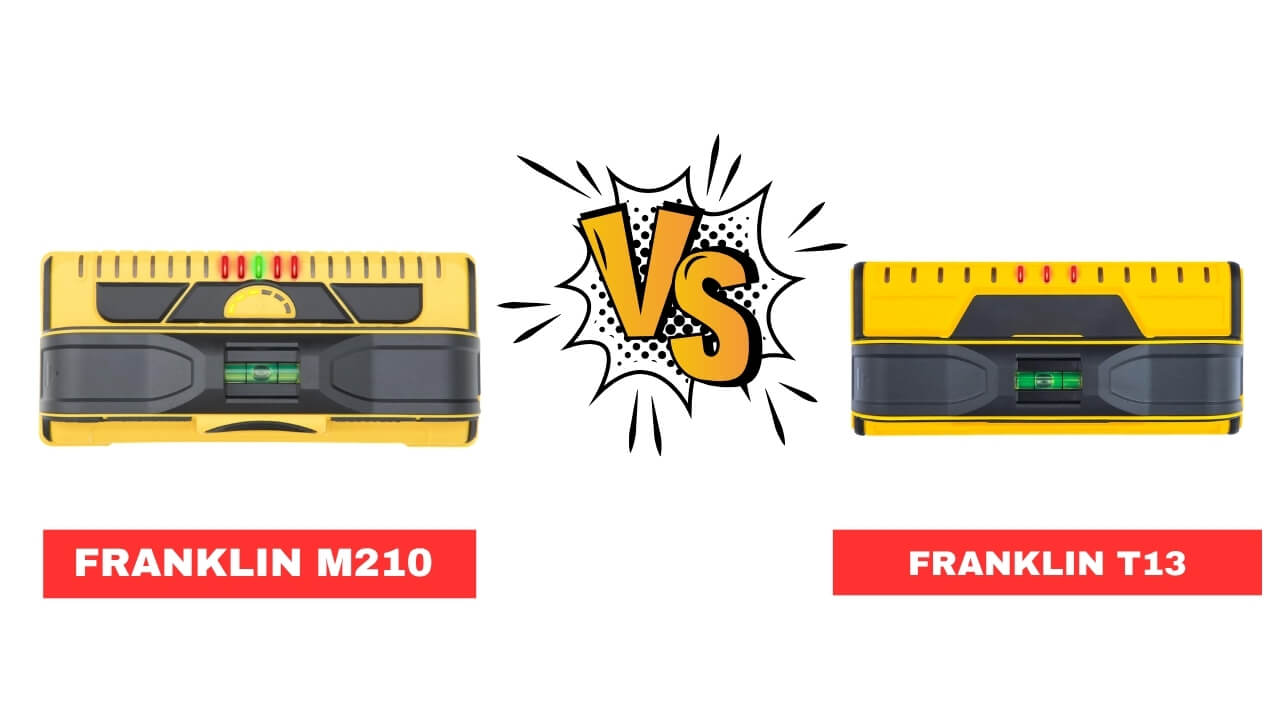
A wall job can seem easy until the wrong spot is marked. A bad mark can waste time or cause damage. The Franklin M210 vs T13 choice comes down to LED display, live-wire checking, and extra tools. This guide breaks down the key differences to help you choose the better fit for your wall work.
Black Friday 2026
Black Friday Sale is LIVE! Don't miss out on today's deals.
Check Price on Amazon As an Amazon Associate I earn from qualifying purchases.Franklin M210 Review
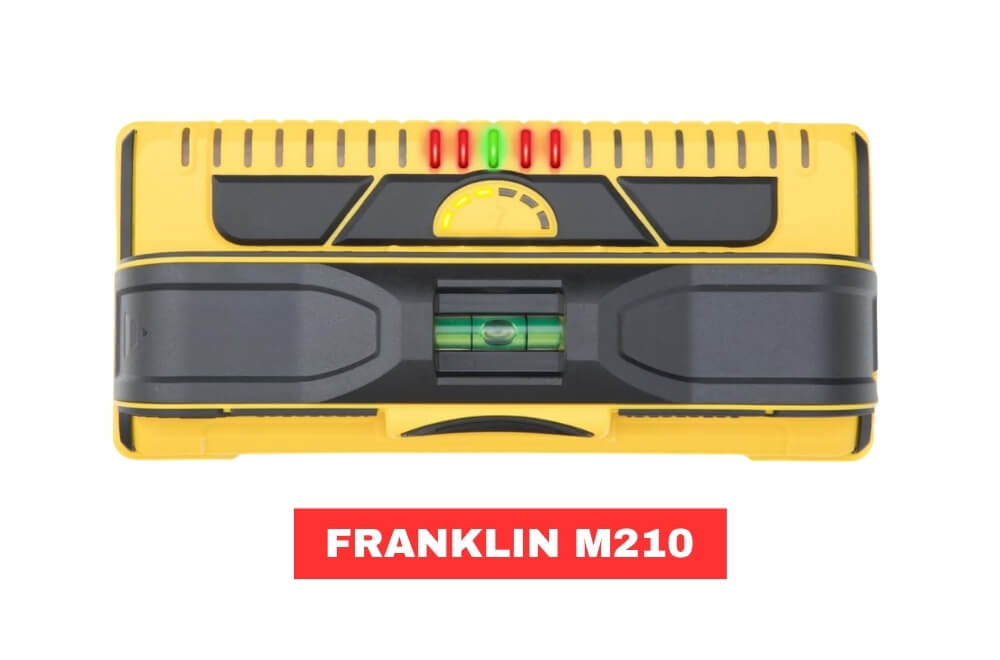
The M210 keeps wall scanning simple and quick. Its 13 sensors and 21 LEDs help show the full stud width more clearly.
Black Friday 2026
Black Friday Sale is LIVE! Don't miss out on today's deals.
Check Price on Amazon As an Amazon Associate I earn from qualifying purchases.Pros and Cons
Quick scanning matters during small jobs. The table below shows the main strengths and limits at a glance.
Black Friday 2026
Black Friday Sale is LIVE! Don't miss out on today's deals.
Check Price on Amazon As an Amazon Associate I earn from qualifying purchases.| Type | Feature | Practical Impact |
|---|---|---|
| Pro | 13 sensors | Helps show the stud area |
| Pro | 21 LEDs | Gives a wider scan display |
| Pro | Live wire meter | Adds a live-wire warning |
| Pro | Bubble level | Helps keep the tool aligned |
| Con | No object identification | A signal does not confirm the object |
| Con | Battery powered | Batteries need to be ready before use |
Everyday Scan Experience
- The LEDs show a scan area as the tool moves across the wall. This makes the stud width easier to see.
- During a small wall job, repeated edge scans may take less time.
- The 21 LEDs give a wide visual signal.
- Still, wall texture, pipes, or other density changes can trigger a signal. A slow repeat scan can help when the result looks unclear.
- The live wire meter adds another useful signal during electrical work. It does not replace safe electrical work practices.
Recommendation
The best fit depends on the type of work. The table below keeps the choice simple.
| User Type | Recommendation | Reason |
|---|---|---|
| DIY users | Good Fit | Easy scan and wide LED display |
| Wall mounting jobs | Good Fit | Stud width is easier to see |
| Electrical work | Good Fit | Includes a live wire meter |
| Simple stud finding | Good Fit | 13 sensors cover core needs |
| Basic budget use | Not Ideal | Extra features may cost more |
Franklin T13 Review
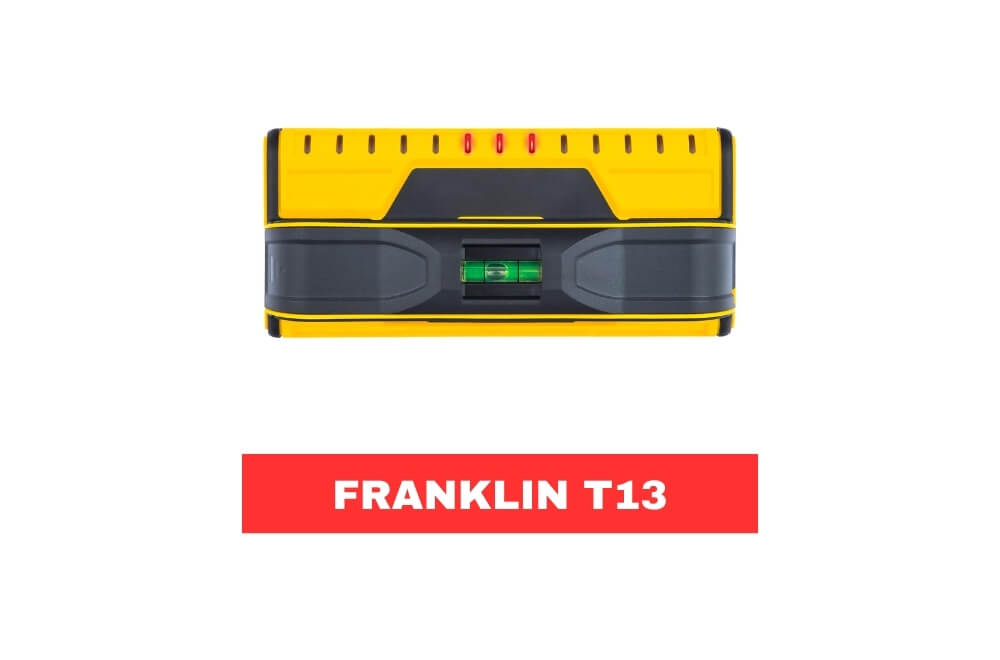
The T13 also uses a 13-sensor design. It adds 13 LEDs, 1.7-inch detection depth, a bubble level, and a ruler.
Pros and Cons
The T13 focuses more on basic wall scanning. Its key strengths and limits are shown below.
| Type | Feature | Practical Impact |
|---|---|---|
| Pro | 13 sensors | Helps detect the stud area |
| Pro | 13 LEDs | Gives a simple scan result |
| Pro | 1.7-inch depth | Useful for common wall jobs |
| Pro | Built-in ruler | Makes marking easier |
| Pro | Bubble level | Helps with straight alignment |
| Con | No live wire meter | No extra live-wire warning |
Simple Wall Work
- Simple controls can make routine wall scans easy.
- A scan across the wall shows density changes through the LED display.
- The 13 sensors detect several points across the wall at once.
- The ruler can help with marking during wall work.
- The bubble level also helps with quick alignment.
- The lack of a live-wire meter means extra care is needed near electrical areas.
- Heavy wall texture can still create signals from other density changes.
Recommendation
Basic stud finding and live-wire checking are different needs. The right choice depends on the job.
| User Type | Recommendation | Reason |
|---|---|---|
| DIY users | Good Fit | Simple wall scanning |
| Picture hanging | Good Fit | Stud finding and ruler help |
| Light repair work | Good Fit | Basic tools are built in |
| Electrical work | Not Ideal | No live wire meter |
| Feature-heavy users | Not Ideal | Fewer extra functions |
Detailed Comparison for Franklin M210 vs T13
Both models use 13 sensors and list a 1.7-inch detection depth. The main gap is in the display and extra features.
Performance: Franklin M210 vs T13
Both models use a full-width stud detection approach. The 13 sensors detect several points across the wall at once.
The M210 uses 21 LEDs for a wider visual display. The T13 uses 13 LEDs for a simpler result. Both models list a 1.7-inch detection depth. So, depth is not a major difference here. The M210 has an edge when wider visual feedback matters.
| Feature | Franklin M210 | Franklin T13 |
|---|---|---|
| Sensors | 13 | 13 |
| LEDs | 21 | 13 |
| Detection depth | 1.7 in | 1.7 in |
| Full-width scanning | Yes | Yes |
| No calibration required | Yes | Yes |
Franklin M210 Rating: 9.5/10
Franklin T13 Rating: 9/10
Ease of Use: Franklin M210 vs T13
Both models can be used without a calibration step before scanning. That makes quick wall checks easier.
The M210 has a wider LED display, which can make the signal easier to read. The T13 has a simpler display that can suit basic users. Both models include a bubble level. The T13 also includes a ruler for marking work. The M210 adds a pencil caddy for quick wall marking.
| Feature | Franklin M210 | Franklin T13 |
|---|---|---|
| Calibration | Not required | Not required |
| Bubble level | Yes | Yes |
| Ruler | Not listed | Yes |
| Pencil caddy | Yes | Not listed |
| LED display | 21 LEDs | 13 LEDs |
Franklin M210 Rating: 9.5/10
Franklin T13 Rating: 9/10
Build Quality: Franklin M210 vs T13
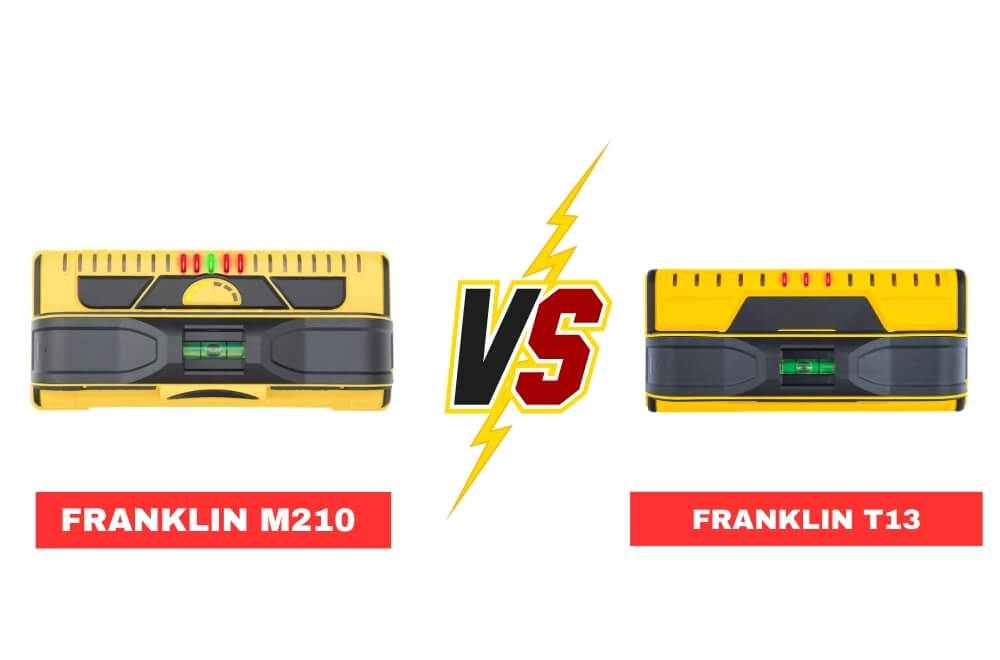
Both models are handheld tools made for wall scanning. Grip, battery access, and simple controls matter during daily use.
The M210 includes a built-in pencil caddy. That small detail can help during quick marking jobs. The T13 includes a ruler for measurement and marking. Both models have a built-in bubble level. Neither model stands out simply because of sensor count.
| Feature | Franklin M210 | Franklin T13 |
|---|---|---|
| Sensor count | 13 | 13 |
| Bubble level | Yes | Yes |
| Pencil caddy | Yes | Not listed |
| Ruler | Not listed | Yes |
| Handheld design | Yes | Yes |
Franklin M210 Rating: 9/10
Franklin T13 Rating: 9/10
Maintenance: Franklin M210 vs T13
Both tools use batteries. Basic care is therefore simple.
During a scan, steady movement can help produce a clear result. The same applies to both models. Heavy wall texture can change the signal. Pipes or wires can also create density changes. A signal should not be treated as proof of a stud without checking the area carefully.
| Feature | Franklin M210 | Franklin T13 |
|---|---|---|
| Battery operation | Yes | Yes |
| Regular calibration | Not required | Not required |
| Heavy texture effect | Possible | Possible |
| Other density changes | Possible | Possible |
| Care level | Low | Low |
Franklin M210 Rating: 9/10
Franklin T13 Rating: 9/10
Value for Money: Franklin M210 vs T13
The price gap is small, but the feature gap can matter based on the job. Listed prices are $59.99 for the M210 and $54.99 for the T13.
The T13 gives basic stud finding with 13 sensors at a lower listed price. The M210 adds 21 LEDs and a live wire meter for a small price increase. Electrical work or wider visual feedback can make the extra cost more useful. Basic stud finding, ruler use, and leveling may make the T13 a better fit. Value depends on the features needed, not price alone.
| Feature | Franklin M210 | Franklin T13 |
|---|---|---|
| Sensors | 13 | 13 |
| LEDs | 21 | 13 |
| Live wire meter | Yes | No |
| Ruler | Not listed | Yes |
Franklin M210 Rating: 9.5/10
Franklin T13 Rating: 9/10
Conclusion
The Franklin M210 vs T13 comparison shows a clear split. The M210 offers more features, with a wider LED display and live wire meter. The T13 can be more practical for basic stud finding, ruler use, and simple wall work.
5 FAQs
-
Which is better, Franklin M210 vs T13?
The M210 offers more features. The T13 is simpler for basic stud finding.
-
Does the Franklin M210 scan deeper than the T13?
No. Both models list a detection depth of 1.7 inches.
-
Does the Franklin T13 have a live wire meter?
No. The live wire meter is an extra feature on the M210.
-
How many sensors do the Franklin M210 and T13 have?
Both models have 13 sensors.
-
Which is better for DIY work, Franklin M210 vs T13?
The T13 can work well for basic wall jobs. The M210 is a better fit when wider LED feedback and live-wire detection are useful.
Authoritative References
- Official M210 Product Information: ProSensor M210 Official Product Page
- Official T13 Product Information: ProSensor T13 Official Product Page
- Official M210 Instructions: M210 Official Instruction Manual (PDF)
- Official T13 Instructions: T13 Official Instruction Manual (PDF)
- Official Instructions Hub: Official Instruction Manuals & Quick Start Videos