
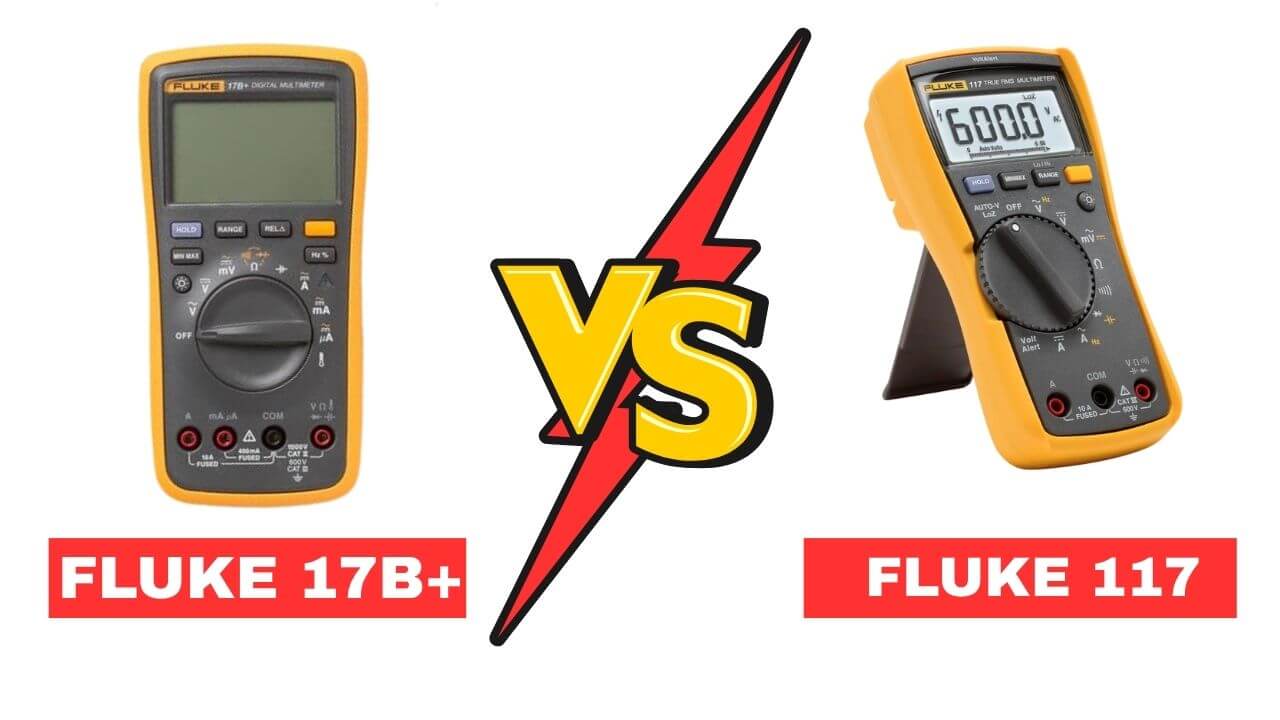
The wrong tool can turn a quick check into a long hunt. This guide compares the Fluke 17B+ and the Fluke 117 to help you pick the right meter. It looks at real features, daily use, safety, and value. Both meters handle basic tests, but they serve different needs. Read on to find the best fit.
Fluke 17B+ Review
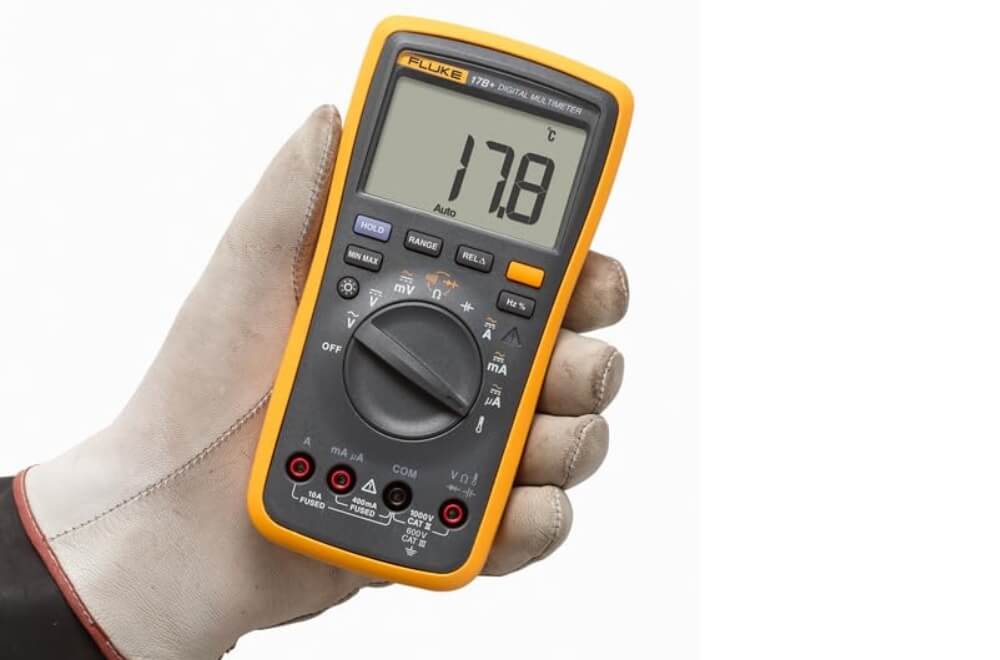
The 17B+ feels like a broad test tool. It checks voltage, current, resistance, capacitance, frequency, duty cycle, and temperature. The 4000-count screen is clear and simple. A bright backlight helps when your work area is dark.
It has a strong set of features for daily checks. Still, it lacks a few features that can help with faster voltage checks.
Pros and Cons
The feature list is strong for routine work. Still, a few limits matter when faster voltage checks are needed.
| Type | Feature | Practical Impact |
|---|---|---|
| Pro | 1000 V range | Gives more range for many checks |
| Pro | Temperature test | Useful for basic temperature checks |
| Pro | Capacitance & frequency | Covers more common jobs |
| Pro | Backlit display | Easier to read in low light |
| Con | 4000-count display | Shows less detail than a 6000-count screen |
| Con | No Auto-V/LoZ | Requires more care during voltage checks |
Daily Use Feel
This meter handles many jobs in one day. You can check volts, ohms, and temperature without swapping tools. The screen is easy to read, and the light helps in dark spots. Yet, it shows less detail than the 117.
It also lacks Auto-V/LoZ. That feature can help reduce false voltage readings caused by ghost voltage. The 17B+ instead gives you a wider 1000 V range and temperature measurement.
| User Type | Best Fit? | Reason |
|---|---|---|
| DIY users | Good Fit | Wide range of common tests |
| Electronics users | Good Fit | Capacitance and frequency help |
| General techs | Good Fit | Handles many routine checks |
| Pro electricians | Not Ideal | Lacks Auto-V/LoZ for faster checks |
| High-detail needs | Not Ideal | Screen is limited to 4000 counts |
Fluke 117 Review
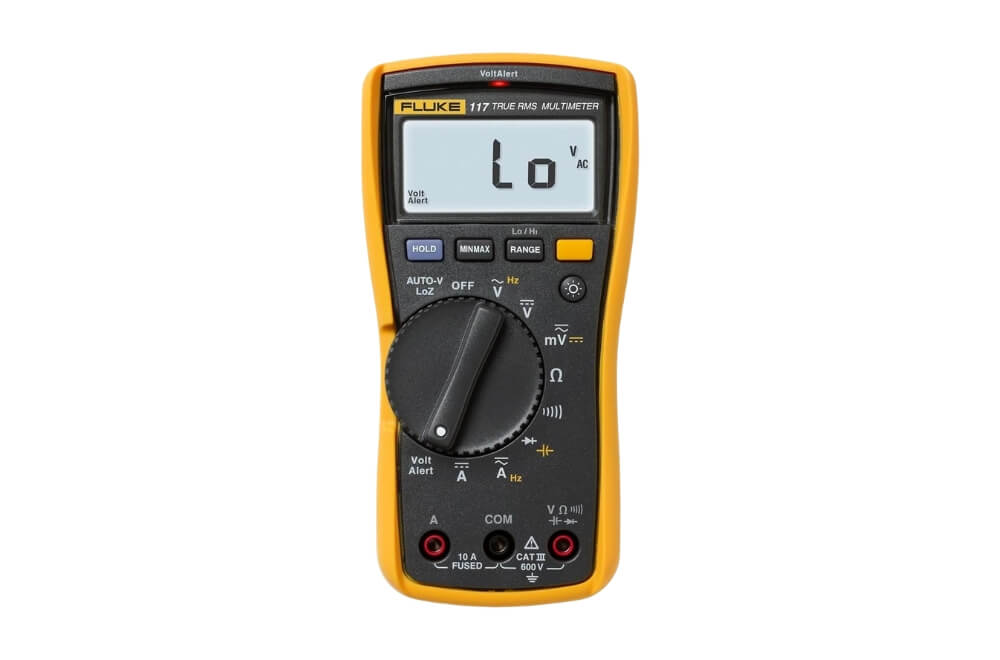
The 117 takes a more focused path. It is built for fast electrical work. It has a sharp 6000-count screen and uses Auto-V/LoZ. It also adds True RMS for AC voltage and current readings.
This design can speed up repeated electrical checks. That helps when a job needs many tests in a row. The main trade-off is the 600 V limit.
Pros and Cons
The design puts more focus on fast electrical checks. That can feel helpful when a job involves repeated voltage tests.
| Type | Feature | Practical Impact |
|---|---|---|
| Pro | 6000-count display | Shows more detail at a glance |
| Pro | Auto-V/LoZ | Helps reduce false voltage readings |
| Pro | True RMS AC | Useful for non-linear AC loads |
| Pro | 600 V CAT III | Fits many electrical service tasks |
| Con | 9 V battery | Uses a different battery setup |
| Con | 600 V max | Lower voltage limit than the 17B+ |
Daily Use Feel
The sharp screen gives numbers more room to breathe. Small changes are easy to see fast. Auto-V/LoZ helps reduce false voltage readings during busy jobs. This meter works well for fast, repeated tests.
The main trade-off is the 600 V limit. The 17B+ goes up to 1000 V. So, the 117 fits focused electrical work, while the 17B+ gives more voltage range.
| User Type | Best Fit? | Reason |
|---|---|---|
| Electricians | Good Fit | Auto-V/LoZ aids voltage checks |
| Service techs | Good Fit | Strong focus on electrical testing |
| True RMS needs | Good Fit | True RMS AC is built in |
| 1000 V needs | Not Ideal | Maximum limit is 600 V |
| Temperature needs | Not Ideal | Temperature measurement is not a standard 117 feature |
Detailed Comparison: Fluke 17B+ vs 117
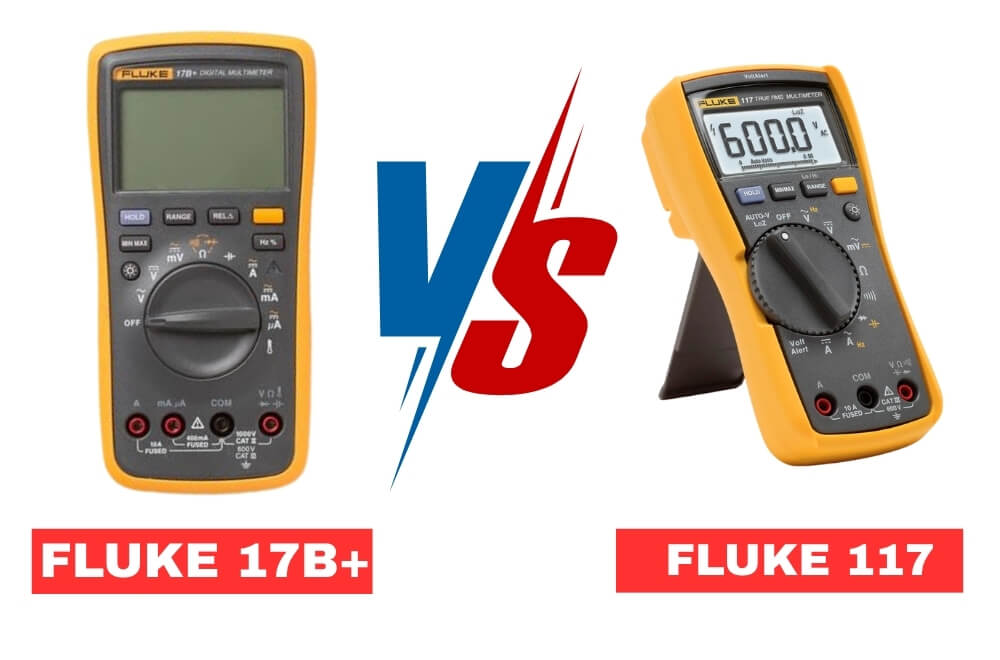
Let us put both meters side by side. These five areas matter most for daily use.
1. Performance: Fluke 17B+ vs 117
Both handle core voltage, current, ohms, frequency, and capacitance. The big difference is how they do it. The 17B+ reaches 1000 V. The 117 stops at 600 V.
The 117 adds True RMS and Auto-V/LoZ for electrical checks. The 17B+ answers back with temperature measurement. So, each meter has a clear strength.
| Feature | Fluke 17B+ | Fluke 117 |
|---|---|---|
| AC voltage | Up to 1000 V | Up to 600 V |
| Display | 4000 counts | 6000 counts |
| True RMS AC | No | Yes |
| Auto-V/LoZ | No | Yes |
| Temperature test | Yes | No |
Fluke 17B+ Rating: 8.5/10
Fluke 117 Rating: 9/10
2. Ease of Use: Fluke 17B+ vs 117
Simple controls save time on rushed jobs. The 17B+ puts many test modes in one tool. This is great for mixed tasks. The 117 has fewer extra modes, but it makes voltage checks faster. Auto-V/LoZ can reduce the need for manual range selection.
The 6000-count screen also shows more detail. The 17B+ has a useful backlight and a wider set of test modes. So, ease of use depends on the type of job.
| Feature | Fluke 17B+ | Fluke 117 |
|---|---|---|
| Display count | 4000 | 6000 |
| Backlight | Yes | Yes |
| Auto range | Yes | Yes |
| Auto-V/LoZ | No | Yes |
| Temperature mode | Yes | No |
Fluke 17B+ Rating: 8.5/10
Fluke 117 Rating: 9/10
3. Build Quality: Fluke 17B+ vs 117
Both tools are made for real electrical work. The 117 is physically shorter and less wide, but it actually weighs more. Neither choice should be judged by size alone. The best fit depends on how it feels in your hand.
The 17B+ lists an IP40 rating and weighs 455 g. The 117 weighs 550 g and has a 3-year warranty.
| Feature | Fluke 17B+ | Fluke 117 |
|---|---|---|
| Height | 183 mm | 167 mm |
| Width | 91 mm | 84 mm |
| Weight | 455 g | 550 g |
| Safety rating | CAT III 600 V, CAT II 1000 V | CAT III 600 V |
| Warranty | Check regional terms | 3 years |
Fluke 17B+ Rating: 8/10
Fluke 117 Rating: 8.5/10
4. Maintenance: Fluke 17B+ vs 117
Battery choice can become annoying over time. The 17B+ uses two AA batteries and has a listed battery life of at least 500 hours. The 117 uses one 9 V battery and has a listed life of about 400 hours.
Both are easy to manage. The 17B+ runs a bit longer on the listed battery figure. That gives it a small edge for regular use.
| Feature | Fluke 17B+ | Fluke 117 |
|---|---|---|
| Battery | 2 AA | 1 × 9 V alkaline |
| Battery life | 500 hours minimum | 400 hours typical |
| Backlight | Yes | Yes |
| Fuse protection | Yes | Yes |
| Temperature test | Yes | No |
Fluke 17B+ Rating: 9/10
Fluke 117 Rating: 8.5/10
5. Value for Money: Fluke 17B+ vs 117
Value depends on what you actually use. The 17B+ gives a wide test set, temperature checks, and 1000 V. That is great if you want one tool for many jobs.
The 117 puts more value into electrical features. True RMS, Auto-V/LoZ, and a 6000-count screen matter a lot for focused electrical work.
| Feature | Fluke 17B+ | Fluke 117 |
|---|---|---|
| Broad testing | Strong | Moderate |
| Electrical focus | Moderate | Strong |
| Temperature test | Yes | No |
| Auto-V/LoZ | No | Yes |
| 1000 V range | Yes | No |
Fluke 17B+ Rating: 9/10
Fluke 117 Rating: 9/10
Conclusion
The right choice comes down to your daily tasks. The 17B+ is best if you want broad tests, temperature checks, and a 1000 V range. The 117 is best if you want True RMS, Auto-V/LoZ, and a sharp 6000-count screen. For focused electrical work, the 117 has the stronger edge.
FAQs
1. Is Fluke 17B+ vs 117 better for electricians?
The 117 is generally better for electricians because it adds True RMS and Auto-V/LoZ.
2. Does the Fluke 17B+ measure temperature?
Yes. The 17B+ can measure temperature with a K-type thermocouple.
3. Does the Fluke 117 measure temperature?
No. The standard 117 does not list temperature measurement as a core feature.
4. Which has the higher voltage limit?
The 17B+ reaches 1000 V. The 117 stops at 600 V.
5. Which has the better display?
The 117 wins here. It has a 6000-count screen, while the 17B+ has a 4000-count screen.