
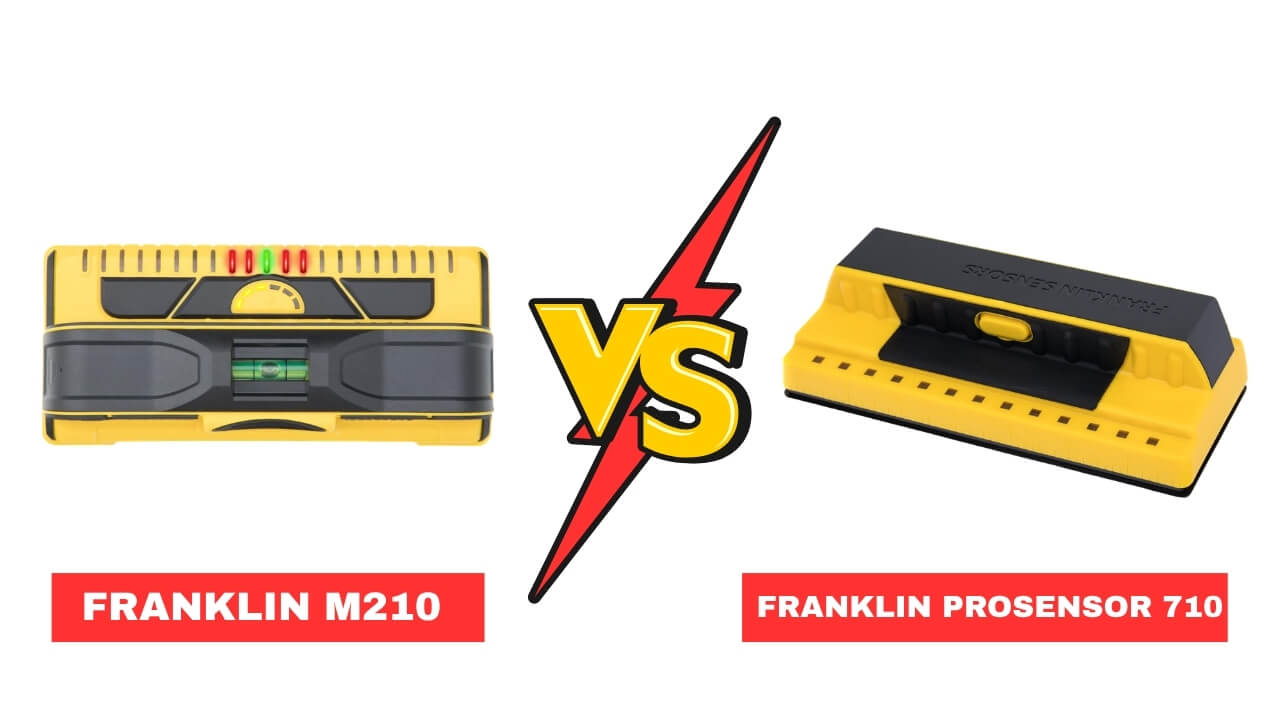
A wall job can feel easy until a drill lands in the wrong spot. A weak scan can waste time and lead to a wrong mark. Franklin M210 vs 710 comes down to scan depth, display width, and extra tools. This guide makes the better fit easier to spot.
Black Friday 2026
Black Friday Sale is LIVE! Don't miss out on today's deals.
Check Price on Amazon As an Amazon Associate I earn from qualifying purchases.Franklin M210 Review
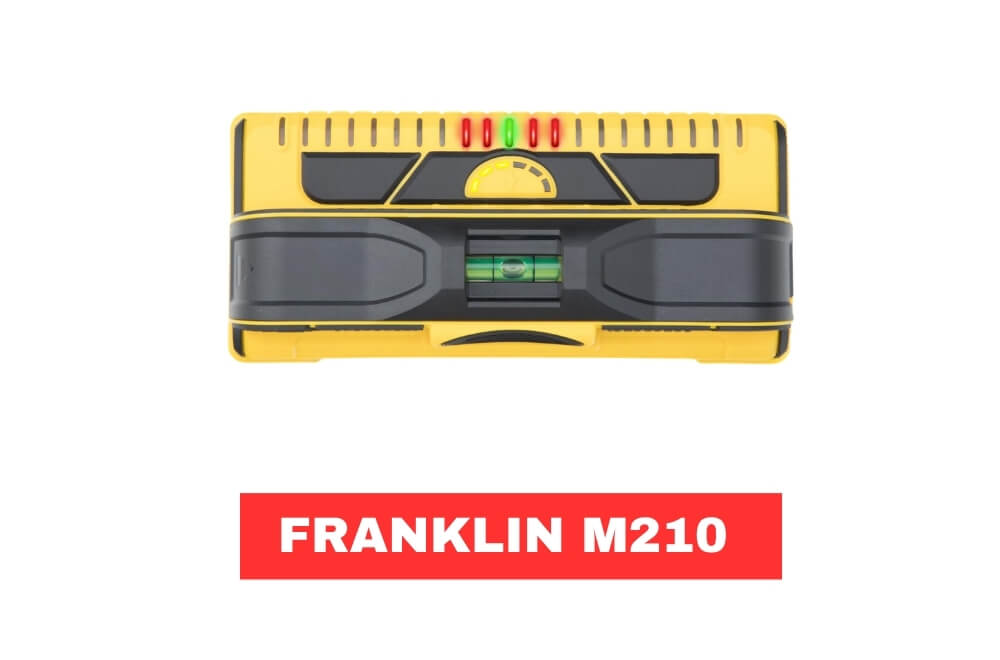
The M210 is built for more than basic stud finding. It uses 13 sensors and 21 LEDs, with a listed detection depth of 1.7 inches. It also adds a bubble level, live wire meter, and pencil caddy.
Black Friday 2026
Black Friday Sale is LIVE! Don't miss out on today's deals.
Check Price on Amazon As an Amazon Associate I earn from qualifying purchases.Pros and Cons
The main strengths are easy to spot.
The limits matter too, especially for simple jobs.
Black Friday 2026
Black Friday Sale is LIVE! Don't miss out on today's deals.
Check Price on Amazon As an Amazon Associate I earn from qualifying purchases.| Type | Feature | Practical Impact |
|---|---|---|
| Pro | 13 sensors | Shows a wide stud area |
| Pro | 21 LEDs | Gives more scan detail |
| Pro | Live wire meter | Adds a live-wire warning |
| Pro | Built-in bubble level | Helps with simple layout work |
| Con | 1.7-inch depth | Has a set detection depth |
| Con | More features | May be more than basic jobs need |
Daily Wall Scanning
The 21-LED display shows the width of a hidden object across a broad area. This can make stud edges and centers easier to judge. The M210 also needs no calibration before a scan.
The built-in bubble level can help with quick layout work. The pencil caddy keeps a marking tool close at hand. The live wire meter adds a separate warning when live electrical wiring is detected.
Recommendation
The M210 makes more sense when wall work needs extra tools. It is less compelling when only basic stud finding is needed.
| User Type | Recommendation | Reason |
|---|---|---|
| DIY users | Good Fit | Easy scanning with useful extras |
| Remodelers | Good Fit | Wide LED display helps with marking |
| Basic wall jobs | Not Ideal | Extra tools may not be needed |
| Users checking for live wires | Good Fit | Includes a live wire meter |
| Simple layout work | Good Fit | Built-in level adds value |
ProSensor 710 Review
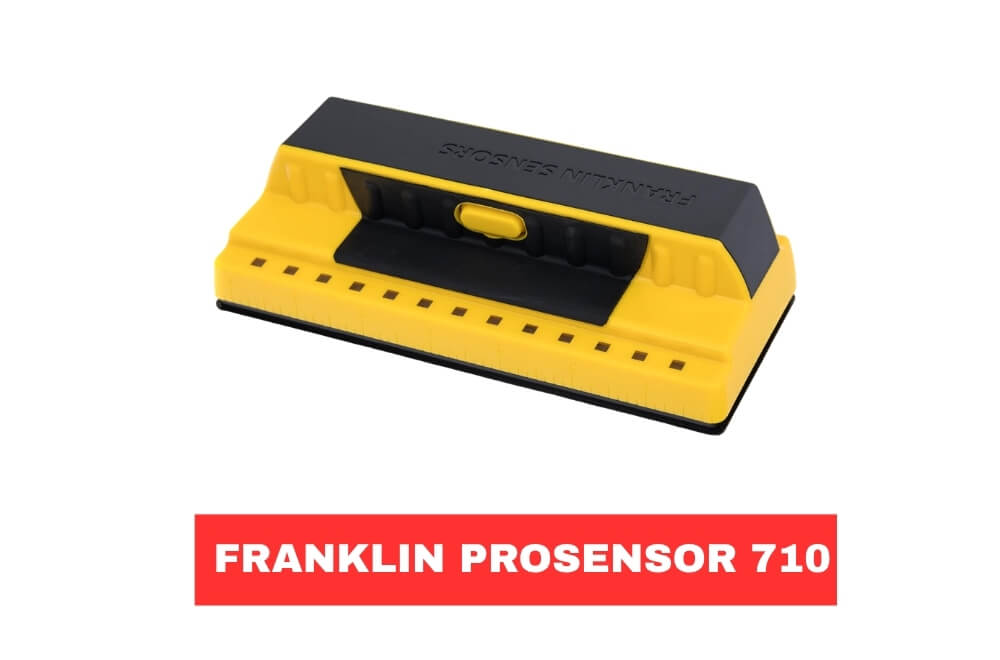
The 710 keeps the job focused on stud finding. It uses 13 sensors and 13 LEDs, with a listed detection depth of 1.6 inches. A ruler is built into the design.
Pros and Cons
The 710 focuses on the core scanning job.
Its simpler feature set can suit users who do not need extra tools.
| Type | Feature | Practical Impact |
|---|---|---|
| Pro | 13 sensors | Scans several areas at once |
| Pro | 13 LEDs | Shows stud width and position |
| Pro | 1.6-inch depth | Covers its listed scan range |
| Pro | Ruler | Helps with quick measurements |
| Con | No live wire meter | No dedicated live-wire meter |
| Con | Fewer LEDs | Gives less display detail than M210 |
Simple Stud Finding
For regular wall scans, the 710 keeps the process simple. Its 13 sensors scan several points at once, so the tool can show the width and location of a hidden object.
No calibration is required before use. The ruler can help with quick marks and measurements. The main focus stays on finding studs rather than adding several extra tools.
Recommendation
The 710 suits users who want a focused stud finder. It can be a better match when extra features are not a priority.
| User Type | Recommendation | Reason |
|---|---|---|
| Beginners | Good Fit | Simple one-button operation |
| Basic DIY users | Good Fit | Focuses on stud finding |
| Simple wall scans | Good Fit | Uses 13 sensors |
| Users checking for live wires | Not Ideal | No dedicated live wire meter |
| Users wanting a built-in level | Not Ideal | No bubble level listed |
Detailed Comparison for Franklin M210 vs 710
Both models use 13 sensors to scan several areas at the same time. The main gaps are display detail, detection depth, and added tools.
Performance: Franklin M210 vs 710
Both models use 13 sensors and can show the width of a hidden object. The M210 lists a 1.7-inch detection depth, while the 710 lists 1.6 inches.
The depth gap is small. The M210 has the wider 21-LED display, while the 710 uses 13 LEDs. Both models should still be used with care around pipes, wires, and other hidden objects.
| Feature | Franklin M210 | ProSensor 710 |
|---|---|---|
| Sensors | 13 | 13 |
| Detection depth | 1.7 in | 1.6 in |
| Stud tracking | Full width | Full width |
| Calibration | Not required | Not required |
| Rating | 9.5/10 | 9/10 |
- Franklin M210 Rating: 9.5/10
- ProSensor 710 Rating: 9/10
Display: Franklin M210 vs 710
The display is one of the clearest differences. The M210 uses 21 LEDs, while the 710 uses 13 LEDs.
The wider LED display can show more detail across the scan area. This can help when checking the width of studs or irregular hidden objects. The 710 still gives a direct visual indication of the detected area.
| Feature | Franklin M210 | ProSensor 710 |
|---|---|---|
| LED count | 21 | 13 |
| Display detail | Higher | Basic |
| Full-width view | Yes | Yes |
| Rating | 9.5/10 | 8.8/10 |
- Franklin M210 Rating: 9.5/10
- ProSensor 710 Rating: 8.8/10
Ease of Use: Franklin M210 vs 710
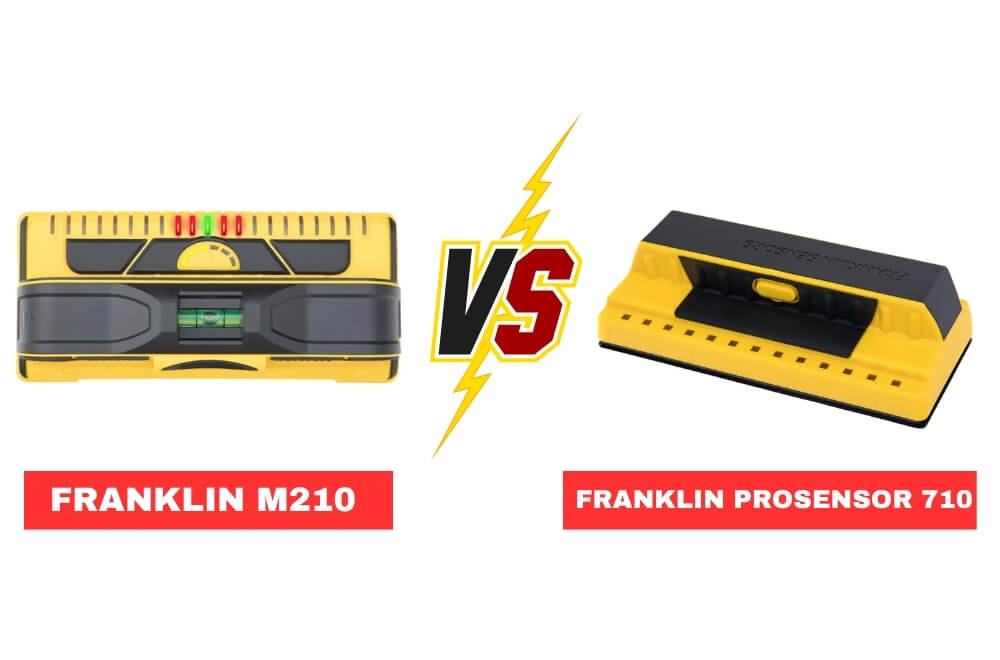
Neither model requires a normal calibration step before scanning. Both are designed around simple button operation, which keeps the basic process easy to follow.
The 710 has a more focused feature set. The M210 adds a live wire meter, bubble level, and pencil caddy. For simple stud finding, both keep the operation straightforward.
| Feature | Franklin M210 | ProSensor 710 |
|---|---|---|
| Calibration | Not required | Not required |
| Basic operation | Simple | Simple |
| Extra tools | More | Fewer |
| Rating | 9.4/10 | 9.2/10 |
- Franklin M210 Rating: 9.4/10
- ProSensor 710 Rating: 9.2/10
Extra Features: Franklin M210 vs 710
This is where the M210 has a clear advantage. It includes a live wire meter, built-in bubble level, and pencil caddy.
The 710 includes a ruler and keeps the design focused on stud finding. The M210 is better suited to users who can use several added tools, while the 710 fits users who want a simpler setup.
| Feature | Franklin M210 | ProSensor 710 |
|---|---|---|
| Live wire meter | Yes | No |
| Bubble level | Yes | No |
| Pencil caddy | Yes | No |
| Ruler | Not listed | Yes |
| Rating | 9.6/10 | 8.7/10 |
- Franklin M210 Rating: 9.6/10
- ProSensor 710 Rating: 8.7/10
Value for Money: Franklin M210 vs 710
The official product listings show a small price gap. The M210 is listed at $59.99, while the 710 is listed at $52.95. That makes the listed difference $7.04.
The M210 adds several tools for that extra cost. The 710 can still make sense when basic stud finding is the main goal. Actual store prices can change, so the current listing should be checked before buying.
| Feature | Franklin M210 | ProSensor 710 |
|---|---|---|
| Feature range | Higher | Basic |
| Best value for | More tools | Simple scans |
| Rating | 9.4/10 | 9.1/10 |
- Franklin M210 Rating: 9.4/10
- ProSensor 710 Rating: 9.1/10
Conclusion
The Franklin M210 vs 710 choice is fairly simple. The 710 is a strong fit for basic stud finding, while the M210 is better when a wider LED display, live wire meter, bubble level, and extra depth are useful.
FAQs
-
Is the M210 deeper than the 710?
Yes. The M210 lists a 1.7-inch detection depth, while the 710 lists 1.6 inches.
-
Do both models use 13 sensors?
Yes. Both models use 13 sensors for wall scanning.
-
Does the 710 have a live wire meter?
No. The official 710 product page does not list a live wire meter. The M210 includes a live wire meter.
-
Which model has more LEDs?
The M210 has 21 LEDs, while the 710 has 13 LEDs.
-
Which is better for basic stud finding?
The 710 is a good fit when basic stud finding is the main task. The M210 is better when extra tools are useful.