
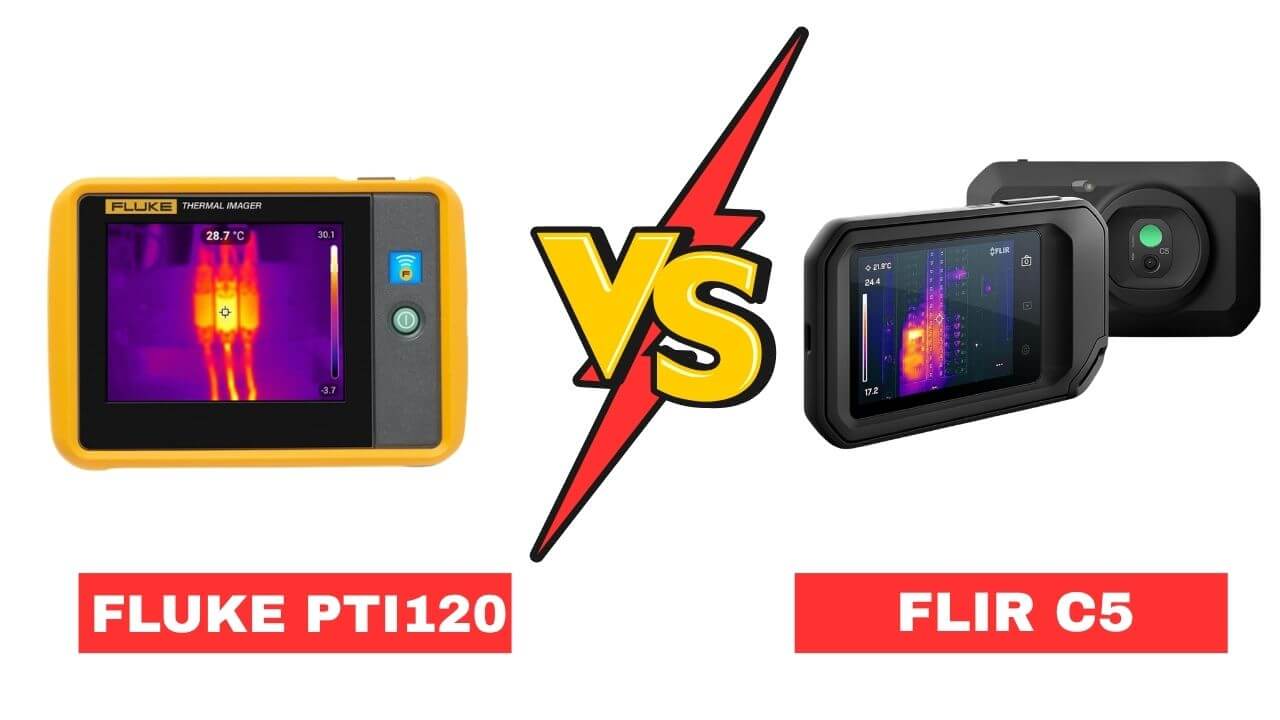
A small heat issue can become a costly repair. A thermal camera can help you spot heat early. The Fluke PTi120 vs FLIR C5 choice can feel hard at first.
Both cameras are small and easy to carry. But the key features are quite different. This guide keeps the choice simple. It looks at image detail, ease of use, build, battery, focus, and file use.
You will also see which camera fits each type of user. The goal is simple. You can choose the tool that fits your work.
Fluke PTi120 Review
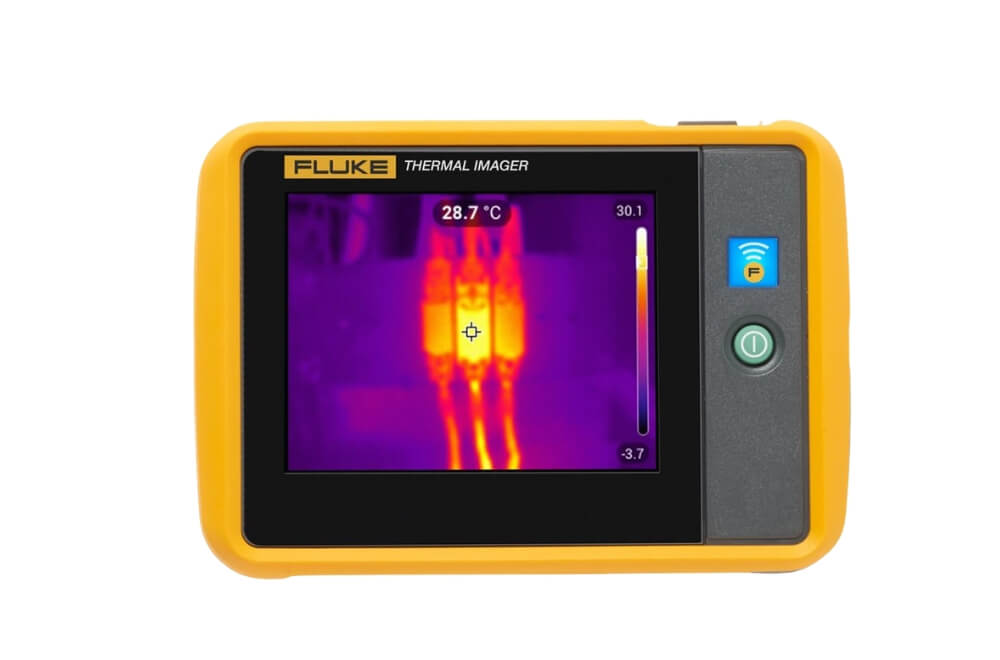
The Fluke PTi120 is made for quick thermal checks. It has a 120 × 90 infrared view. That gives 10,800 thermal pixels. It also has a 3.5-inch touch screen.
The camera uses IR-Fusion. This blends thermal and visual details in one view. That can make a hot area easier to spot. The camera also supports asset tagging through its connected workflow.
Pros and Cons
The PTi120 has a simple set of useful tools. It also has a few limits that matter for some jobs.
| Type | Feature | Practical Impact |
| Pro | 120 × 90 thermal view | Gives 10,800 thermal pixels. |
| Pro | 3.5-inch touch screen | Makes scans easy to view. |
| Pro | IR-Fusion | Adds visual detail to heat images. |
| Pro | Asset tagging | Helps link images to assets. |
| Con | Fixed focus | Gives less close-range freedom. |
| Con | 1 m drop rating | Needs care after a hard fall. |
Daily Use
The PTi120 fits quick checks well. It can help with electrical equipment checks. It can also help with machine checks. The touch screen keeps basic work simple.
The 120 × 90 sensor gives 10,800 thermal pixels. That gives a clear heat view for many routine checks. IR-Fusion can also add visible details to the heat image. This can make the hot area easier to understand.
The fixed focus can limit very close work. The minimum focus distance is 22.8 cm. So, close targets need a little more care. For normal scan work, this is less of an issue.
The PTi120 also has a 1 m drop rating. That gives some protection during normal field use. Still, a hard drop can damage any camera. Care is still needed during busy jobs.
Recommendation
The PTi120 is a good fit for focused thermal checks. It can also suit users who need asset tags. The simple design may be enough for many routine jobs.
| User Type | Recommendation | Reason |
| Electricians | Good Fit | Useful for quick heat checks. |
| Maintenance users | Good Fit | Suits machine and equipment checks. |
| Service teams | Good Fit | Simple screen and heat view. |
| Asset teams | Good Fit | Supports asset tagging. |
| Close-range users | Not Ideal | Fixed focus limits close work. |
| Heavy drop users | Not Ideal | The stated rating is 1 m. |
FLIR C5 Review
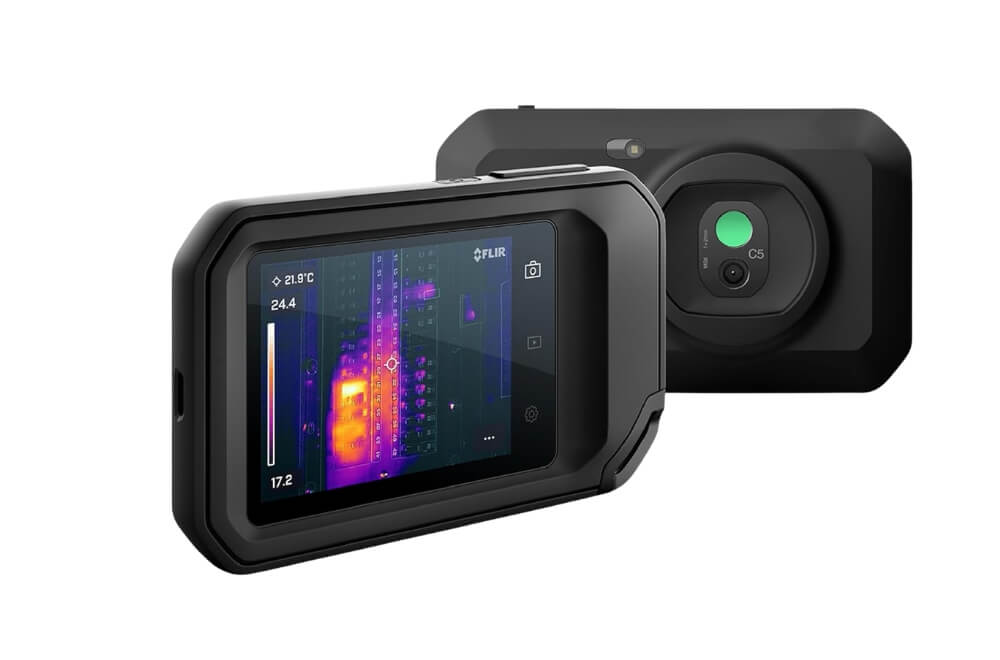
The FLIR C5 puts more focus on image detail. It has a 160 × 120 thermal view. That gives 19,200 thermal pixels. It also has a 5 MP visual camera.
The C5 uses MSX to add visual detail. It also has visual, thermal, and picture-in-picture modes. Wi-Fi adds another useful feature. Images can also be uploaded through cloud connectivity.
Pros and Cons
The C5 has more image tools than the PTi120. It also has a higher thermal pixel count.
| Type | Feature | Practical Impact |
| Pro | 160 × 120 thermal view | Gives 19,200 thermal pixels. |
| Pro | 5 MP visual camera | Adds more scene detail. |
| Pro | MSX | Makes heat images easier to read. |
| Pro | Picture-in-picture | Shows thermal and visual detail together. |
| Pro | 2 m drop rating | Gives a higher stated drop rating. |
| Con | 0.3 m MSX focus range | MSX needs more distance than thermal view. |
Daily Use
The C5 is a strong fit when image detail matters. Its 160 × 120 thermal view gives more pixels. That can help when a small warm area needs more detail. The 5 MP visual camera adds more scene information.
MSX adds visual edges to the thermal image. This can make the image easier to read. The C5 also has several image modes. You can use thermal, visual, MSX, or picture-in-picture views.
Wi-Fi adds another useful part to the workflow. Images can be uploaded through cloud connectivity. This can help when images need to be saved or shared.
The stated battery time is also four hours. The C5 uses USB-C for charging. That is a simple feature for daily use. The camera also has a 2 m stated drop rating. That is higher than the PTi120 rating.
Recommendation
The C5 suits users who want more image detail. It also suits users who save and share many images. The extra image modes can help during detailed inspections.
| User Type | Recommendation | Reason |
| Inspectors | Good Fit | More thermal and visual detail. |
| Electricians | Good Fit | Useful thermal image tools. |
| Service users | Good Fit | Wi-Fi and cloud support help sharing. |
| Users needing more detail | Good Fit | Higher thermal resolution. |
| Basic scan users | Not Ideal | Extra tools may not be needed. |
| MSX close-range users | Not Ideal | MSX has a 0.3 m minimum range. |
Detailed Comparison for Fluke PTi120 vs FLIR C5
The two cameras are close in size and purpose. The biggest gap is thermal image detail. Other gaps show up in use, build, battery, focus, and file work.
1. Performance: Fluke PTi120 vs FLIR C5
Thermal resolution is one of the clearest differences. The PTi120 has a 120 × 90 thermal view. The C5 has a 160 × 120 thermal view. The PTi120 gives 10,800 thermal pixels. The C5 gives 19,200 thermal pixels.
That is a large difference in pixel count. More thermal pixels can help show more detail. This can matter when a small heat area needs a closer look. The C5 also adds a 5 MP visual camera. The PTi120 uses IR-Fusion for added visual detail.
| Feature | Fluke PTi120 | FLIR C5 |
| Thermal view | 120 × 90 | 160 × 120 |
| Thermal pixels | 10,800 | 19,200 |
| Visual detail | IR-Fusion | 5 MP camera + MSX |
| Image modes | IR-Fusion | Thermal, visual, MSX, picture-in-picture |
| Best point | Simple thermal checks | Higher image detail |
2. Ease of Use: Fluke PTi120 vs FLIR C5
Both cameras have a 3.5-inch screen. Both are made for quick checks. The PTi120 keeps the main thermal workflow simple.
The C5 gives more ways to view an image. It has thermal, visual, MSX, and picture-in-picture modes. That gives users more choices during a scan.
The PTi120 also supports asset tagging. This can help keep images linked to the right asset. The C5 adds Wi-Fi and cloud connectivity. That can help when images need to be saved or shared.
| Feature | Fluke PTi120 | FLIR C5 |
| Screen | 3.5-inch touch screen | 3.5-inch screen |
| Main image tool | IR-Fusion | MSX |
| View modes | IR-Fusion | Thermal, visual, MSX, picture-in-picture |
| Wireless | Wi-Fi | Wi-Fi |
| Best point | Simple workflow | More image choices |
3. Build Quality: Fluke PTi120 vs FLIR C5
Both cameras are made for field inspection. The PTi120 has a 1 m drop rating. The C5 has a 2 m drop rating. Both also have IP54 protection. So, both have a stated level of dust and water protection.
The C5 has the higher stated drop rating. That can be useful when a camera is used on busy jobs.
The PTi120 is also a compact tool. Its official weight is about 0.233 kg. The supplied product data listed a higher weight. The official figure should be used for the article.
| Feature | Fluke PTi120 | FLIR C5 |
| Drop rating | 1 m | 2 m |
| Protection | IP54 | IP54 |
| Weight | About 0.233 kg | Not stated in supplied data |
| Main strength | Compact field use | Higher stated drop rating |
4. Battery and Charging: Fluke PTi120 vs FLIR C5
Battery time can matter during a long job. The PTi120 has a stated run time of at least two hours. That figure applies without Wi-Fi. The C5 has a stated battery time of four hours. So, the C5 has the higher stated battery time. This can matter during longer inspection sessions.
The charging ports are also different. The PTi120 uses Mini USB. The C5 uses USB-C. Both use rechargeable lithium-ion batteries.
| Feature | Fluke PTi120 | FLIR C5 |
| Stated battery time | At least 2 hours | 4 hours |
| Charging port | Mini USB | USB-C |
| Battery type | Rechargeable lithium-ion | Rechargeable lithium-ion |
| Best point | Simple battery system | Longer stated battery time |
5. Close Work and Focus: Fluke PTi120 vs FLIR C5
Focus can matter when the target is close. The PTi120 uses fixed focus. Its minimum focus distance is 22.8 cm.
The C5 uses a focus-free system. Its minimum thermal focus distance is 0.1 m. For MSX, the listed minimum distance is 0.3 m. That gives the C5 more freedom for close thermal work. Still, MSX has a longer minimum distance than the thermal view. This point matters when the target is very close.
| Feature | Fluke PTi120 | FLIR C5 |
| Focus type | Fixed focus | Focus free |
| Thermal focus | 22.8 cm minimum | 0.1 m minimum |
| MSX focus | Not listed | 0.3 m minimum |
| Close work | More limited | More flexible |
| Best point | Simple scan work | Close thermal view |
6. Image and File Use: Fluke PTi120 vs FLIR C5
Image work is another key difference. The PTi120 uses IR-Fusion. It also supports asset tagging.
The C5 adds MSX and several image modes. It also has a 5 MP visual camera. This gives more visual information beside the thermal image. The C5 can save JPEG files. It also supports measurement data in the image file. The camera can store more than 5,000 images. The PTi120 also supports image storage and asset tagging.
| Feature | Fluke PTi120 | FLIR C5 |
| Main image tool | IR-Fusion | MSX |
| Visual camera | IR-Fusion view | 5 MP |
| Image format | JPEG and IS2 | JPEG |
| Image storage | 2 GB internal flash | More than 5,000 images |
| Best point | Asset image work | More image options |
7. Value for Money: Fluke PTi120 vs FLIR C5
Value depends on the work. A simple heat check may not need every extra feature. A more detailed job may benefit from more image tools.
The PTi120 focuses on core thermal checks. It also supports asset tagging. This can make it useful for users who need a focused tool.
The C5 gives more thermal pixels. It also adds a 5 MP camera and more image modes. Its stated battery time is also higher. These features can matter when image detail and sharing are important.
| Feature | Fluke PTi120 | FLIR C5 |
| Thermal detail | Good | Higher |
| Image tools | Core tools | More options |
| Battery time | Lower stated time | Higher stated time |
| Cloud use | Connected workflow | FLIR Ignite |
| Best value fit | Focused inspection | Feature-rich inspection |
Conclusion
The Fluke PTi120 vs FLIR C5 choice depends on your main need. The PTi120 fits focused thermal checks and asset work well. The C5 is the stronger fit for higher thermal detail and more image tools. For longer battery time and close thermal work, the C5 also has clear advantages.
Meta Information
-
Meta Description: Fluke PTi120 vs FLIR C5 compared by heat detail, image tools, battery, focus, build, and value to help you choose the right camera.
-
SEO Title: Fluke PTi120 vs FLIR C5: 7 Key Differences
-
URL Slug: fluke-pti120-vs-flir-c5
Authoritative References
-
Fluke PTi120 official product information
-
Fluke PTi120 official technical data
-
Fluke PTi120 official specifications
-
FLIR C5 official product information
FAQs
Is the FLIR C5 better for image detail?
Yes. The C5 has a 160 × 120 thermal view. The PTi120 has a 120 × 90 thermal view. So, the C5 has more thermal pixels.
Does the Fluke PTi120 have IR-Fusion?
Yes. The PTi120 uses IR-Fusion. It adds visual detail to the thermal image. This can make heat areas easier to understand.
Which camera has longer battery life?
The C5 has the higher stated battery time. Its stated time is four hours. The PTi120 has at least two hours without Wi-Fi.
Which camera has the higher drop rating?
The C5 has the higher stated rating. It is rated for a 2 m drop. The PTi120 is rated for a 1 m drop.
Which camera is better for close thermal work?
The C5 has the stronger focus specification. Its thermal minimum focus distance is 0.1 m. The PTi120 has a 22.8 cm minimum focus distance. The C5 also has a 0.3 m minimum distance for MSX.
Quick Answer Guide
| Question | Short Answer |
| Better thermal detail? | FLIR C5 |
| IR-Fusion support? | Fluke PTi120 |
| Longer stated battery time? | FLIR C5 |
| Higher stated drop rating? | FLIR C5 |
| Closer thermal focus? | FLIR C5 |
1. Fluke PTi120 Resources: https://www.fluke.com/en-us/product/thermal-cameras/pti120
2. FLIR C5 Resources: https://www.flir.com/products/c5/